Crypto Mining Profitability Calculators: ASIC and GPU Profit at Your Power Price
This mining profitability calculator hub compares four ASIC and GPU rigs by daily profit at your electricity price, then links ten coin calculators. On 18 Nov 2026 at $0.10/kWh, a Bitmain X9 on Monero netted $26.62 a day and a Kaspa KS7 lost $1.65. Slide the rate to test your own.
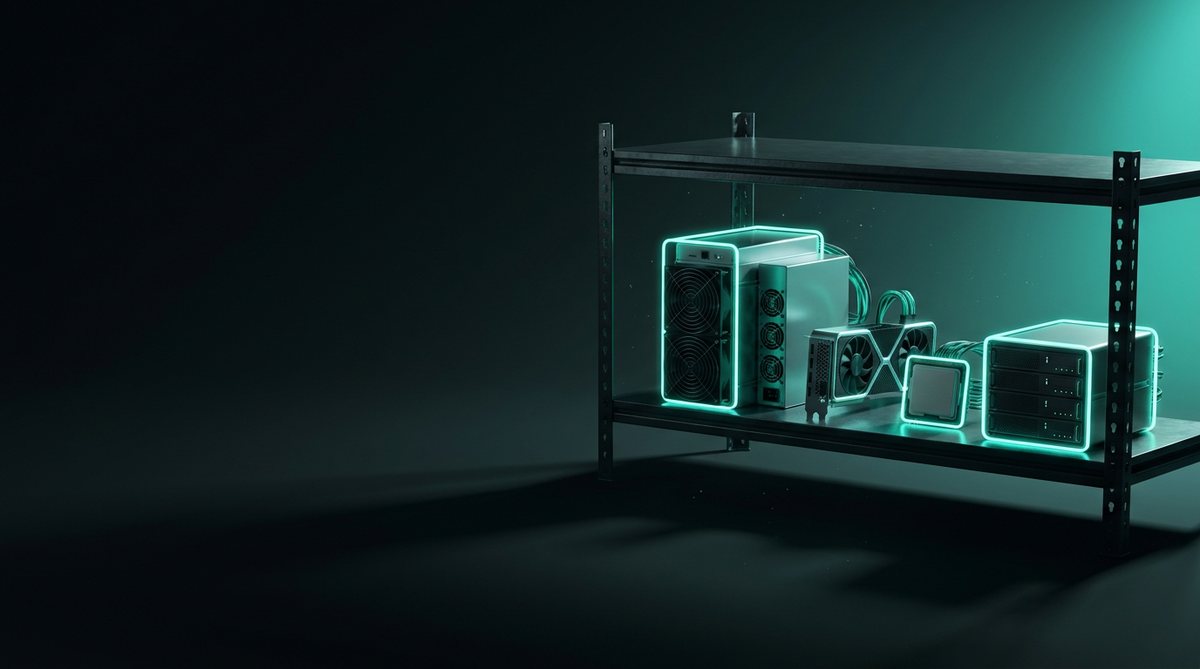
What do four mining rigs earn per day at $0.10/kWh?
Each row is one rig on the coin it mines, priced on 18 Nov 2026. Profit is revenue minus power cost at $0.10/kWh, after a 1% pool fee.
| Coin | Rig and spec | Revenue / day | Power / day at $0.10/kWh | Profit / day |
|---|---|---|---|---|
| Monero (XMR) | Antminer X9, 1,000 kH/s, 2,472 W | $32.56 | $5.93 | $26.62 |
| Zcash (ZEC) | Antminer Z15 Pro, 840 kSol/s, 2,780 W | $29.11 | $6.67 | $22.43 |
| Pearl (PRL) | NVIDIA RTX 5090, 415 Th/s, 560 W | $9.59 | $1.34 | $8.25 |
| Kaspa (KAS) | Antminer KS7, 40 TH/s, 3,080 W | $5.75 | $7.39 | -$1.65 |
Monero leads Zcash by $4.19 a day. A KS7 draws 3,080 W, which costs $7.39 a day at $0.10/kWh, and it mines $5.75 of KAS.
AsicMinerValue lists $23.67 a day for the Z15 Pro and $24.27 for the X9 at about $0.10/kWh, so Monero leads there too.
WhatToMine shows $7.43 profit for the RTX 5090. The snapshot says $8.25, which is 11% higher; it uses a 1% fee and the Pearl calculator’s yield formula, while WhatToMine uses its own fee and network read.
The power price check below recalculates the same four rigs from live feeds as you move the slider.
The power price check still models the KS7 at 45 TH/s, and its Pearl row uses 300 Th/s at 420 W with a fixed 30 Sep yield, so those two profits differ from the table above. Its hint says US homes pay about $0.17, where EIA’s August 2026 figure is 18.16 cents. If a data feed fails it falls back to 30 Sep prices while the status still reads “live data loaded”.
Power price check
loading live data| Coin | Rig | Mined / day | Revenue / day | Power / day | Profit / day |
|---|
One rig per coin at manufacturer specs, 1% pool fee, today’s price and network size. Pearl uses WhatToMine’s conservative 300 Th/s for an RTX 5090. Open each coin’s page for hardware cost, payback and difficulty growth.
How is each rig’s daily profit calculated?
Revenue is coins per day times the CoinGecko price. Power cost is watts / 1,000 × 24 × your price per kWh, and profit is revenue minus power cost.
The 1% pool fee comes off the coins. The network inputs below were read on 18 Nov 2026.
| Coin | Inputs on 18 Nov 2026 | Coins per day |
|---|---|---|
| Kaspa | 313,021 TH/s network hashrate, 1.94454365 KAS per block, 864,000 blocks a day (api.kaspa.org hashrate, block reward) | 40 / 313,021.4 × 1.94454365 × 864,000 × 0.99 = 212.55 KAS |
| Zcash | 37,856,542,880 sol/s network hashrate (zec.2miners.com), 3,456 blocks a day, 0.416667 ZEC miner subsidy per block (Blockchair) | 840,000 / 37,856,542,880 × 3,456 × 0.416667 × 0.99 = 0.0316 ZEC |
| Monero | Difficulty 783,840,246,751, so hashrate is difficulty / 120 = 6.532 GH/s; reward 0.60061278 XMR per block; 720 blocks a day (api.moneroocean.stream) | 1,000,000 / 6,532,002,056 × 720 × 0.60061278 × 0.99 = 0.0655 XMR |
| Pearl | Difficulty 62,079,814, block reward 2,158.56 PRL (prl.2miners.com), so yield is 0.011227 PRL per Th/s a day | 415 × 0.011227 × 0.99 = 4.61 PRL |
Pearl’s yield per Th/s comes from the formula on the Pearl calculator: 0.0224 × (33,090,000 / difficulty) × (block reward / 2,295.55). Today that gives about half of 0.0224, so a calculator that keeps the 30 Sep value roughly doubles the Pearl coins per day.
Zcash’s NU7 upgrade activated on 5 Nov 2026 at block 3,543,405 (Incrypted). It cut the target block interval to 25 seconds and the subsidy threefold, so miners still receive 1,440 ZEC a day.
Kaspa’s block reward follows a monthly cut schedule (Kaspa wiki). It is 1.94454365 KAS now against 2.18267645 on 30 Sep, a drop of 10.9%.
The KS7 is printed at Bitmain’s 40 TH/s and 3,080 W. WhatToMine lists a separate KS7 45T at 45 TH/s and 3,465 W, and on that unit the same snapshot gives 239.1 KAS, $6.46 of revenue, $8.32 of power and a loss of $1.85.
Worked example for the X9: 1,000,000 H/s against 6.532 GH/s is 0.0153% of the network. Over 720 blocks of 0.60061278 XMR and a 1% fee that is 0.0655 XMR, or $32.56 at $496.74.
Power is 2.472 kW × 24 × $0.10 = $5.93, so the X9 nets $26.62 a day.
At what electricity price does each rig stop paying?
The break-even price is daily revenue divided by the kWh a rig uses in a day. Above it, the rig loses money.
| Rig | Energy per day | Break-even price per kWh | Profit per day at $0.1816/kWh |
|---|---|---|---|
| NVIDIA RTX 5090 (Pearl) | 13.44 kWh | $0.714 | $7.15 |
| Antminer X9 (Monero) | 59.33 kWh | $0.549 | $21.78 |
| Antminer Z15 Pro (Zcash) | 66.72 kWh | $0.436 | $16.99 |
| Antminer KS7 (Kaspa) | 73.92 kWh | $0.078 | -$7.68 |
EIA puts the average US residential price at 18.16 cents per kWh for August 2026, up 3.4% on the year. At that price a KS7 spends $13.42 a day on power against $5.75 of revenue, a loss of $7.68.
Hosting is cheaper. SimpleMining lists hosting from $0.065/kWh and $0.08/kWh for its 0 to 499 kW tier, and those prices are for Bitcoin miners. No hosting page for Zcash or Monero ASICs turned up.
The KS7 breaks even at $0.078, just under that $0.08 tier. At $0.065 it would earn $0.94 a day, and at $0.08 it would lose $0.17.
At $0.10/kWh a Z15 Pro burns $6.67 of power a day and mines $29.11 of ZEC.
Slide the price to $0.25/kWh. On the snapshot inputs the X9 still earns $17.73 a day, the Z15 Pro $12.43 and the RTX 5090 $6.23, while the KS7 loses $12.73.
Mining and staking calculators by coin
Seven calculators cover mining and three cover staking, one page per coin.
Mining calculators
Staking calculators
Mining vs staking: what each coin needs and what breaks the math
Mining turns electricity into coins. Your margin is the coin price minus your power bill, and a protocol change or a new rig can erase it.
Staking turns coins into more coins. There is no power bill, but your whole balance rides on the token price.
| Coin | How you earn | Entry cost | What breaks the math |
|---|---|---|---|
| Pearl | GPU mining | An RTX 5090, 4090 or 3090 (WhatToMine lists all three) | Difficulty growth: yield per Th/s is about half its 30 Sep value |
| Kaspa | kHeavyHash ASIC mining | Bitmain lists the KS7 at $1,540, sold out | The monthly emission cut and any power price above $0.078/kWh |
| Zcash | Equihash ASIC mining | Bitmain lists the Z15 Pro at $4,999, sold out, shipping from March 2027 | ZEC giving back its 2026 rally: $1,653 on 27 Sep, $920 on 18 Nov |
| Monero | RandomX mining | Bitmain lists the X9 at $5,600 | A RandomX change that stops the X9 from mining |
| Aleo | Prover ASIC mining | An IceRiver AE3 (2 GH/s, 3,400 W per AsicMinerValue) | The ALEO price against 3,400 W of power draw |
| Nockchain | GPU mining | A GPU | Difficulty growth and the NOCK price |
| Qubic | Mining with a weekly payout | See the Qubic calculator | The payout you assume; the burn rate rose from 55% to 77.5% at Epoch 227 |
| Hyperliquid | Delegate HYPE to a validator | HYPE to stake | A 7-day unstaking queue |
| NetNet | Stake NET, paid every 8 hours | NET bought with a 5% trading levy | A falling NET price outruns the 8-hour distribution |
| Bittensor | Stake TAO to a validator, or mine subnets | TAO to stake, or hardware for a subnet miner | The TAO price |
For proof-of-stake coins without hardware, the staking yield calculator covers ETH, SOL, ADA and other proof-of-stake coins.
How do you use these calculators without fooling yourself?
- Use your real power price. Include delivery charges and taxes. On the KS7’s 3,080 W, each $0.01/kWh costs $0.74 a day.
- Allow for difficulty growth. When more hashrate joins a network, each rig gets fewer coins, and Pearl’s yield per Th/s is already about half its 30 Sep value.
- Stress-test the price. Cut every revenue figure in the snapshot by 40%: the X9 keeps $13.60 a day, the Z15 Pro $10.79, the RTX 5090 $4.41, and the KS7 loses $3.94. A rig that only works at today’s price is a bet on the price.
- Count the exit. Pool fees (1% in the snapshot), payout thresholds, exchange fees and the NetNet 5% levy all come out of your profit.
- Compare with buying. Put the hardware budget into the crypto ROI calculator as a plain buy. Mining has to beat that to be worth the effort.
How long does a mining rig take to pay for itself?
A positive day is not a payback. At the snapshot profit, and if nothing else changes, a Z15 Pro takes 223 days to earn back Bitmain’s $4,999 list price and 299 days at the $6,700 AsicMinerValue shows.
| Rig | Price paid | Profit / day | Days to pay back |
|---|---|---|---|
| Antminer Z15 Pro | Bitmain list price $4,999 | $22.43 | 223 days |
| Antminer Z15 Pro | AsicMinerValue price $6,700 | $22.43 | 299 days |
| Antminer X9 | Bitmain list price $5,600 | $26.62 | 210 days |
| Antminer KS7 | Bitmain list price $1,540 | -$1.65 | Never at $0.10/kWh |
The Z15 Pro ships from March 2027, so today’s $22.43 a day may look different by the time a unit arrives.
Staking removes the power bill and keeps the price risk.
Two videos on Bitcoin mining in 2026
Both videos are about Bitcoin mining, which none of the rigs above mine.
Frequently Asked Questions
What is the most profitable coin to mine in 2026?
On 18 Nov 2026 at $0.10/kWh, Monero on a Bitmain X9 led with $26.62 a day, ahead of Zcash on a Z15 Pro at $22.43, Pearl on an RTX 5090 at $8.25 and Kaspa on a KS7 at -$1.65. The order changes with every price and difficulty move, and the snapshot is refreshed monthly.
Is crypto mining still profitable at home?
It depends on the coin and your rate. At EIA’s August 2026 US residential average of 18.16 cents per kWh, a KS7 loses $7.68 a day, while the X9, Z15 Pro and RTX 5090 still earn $21.78, $16.99 and $7.15. A GPU running Pearl costs $2.44 a day in power at that rate.
Is staking better than mining?
Neither wins on its own. Staking has no power bill or hardware, but your full balance rides on the token price, and Hyperliquid holds unstaked HYPE in a 7-day queue. Mining risk sits in hardware and electricity, so pick the risk you can check and price before you commit.
How accurate are mining calculators?
They are accurate for the day they run, and inputs drift fast. Since 30 Sep, Kaspa’s block reward fell 10.9% and Pearl’s yield per Th/s halved, so treat every payback period as a guess. Test a price 40% lower before you buy hardware.
Which mining calculator should I start with?
Start with the coin your hardware fits: a gaming GPU points to Pearl and a spare CPU to Monero. For an ASIC, Bitmain lists the KS7 at $1,540, the Z15 Pro at $4,999 and the X9 at $5,600. Hardware-free staking fits Bittensor, NetNet or Hyperliquid.
Sources
Written by Coinro Editorial. Prices are from CoinGecko, 18 Nov 2026. Specs, prices and network data were read the same day.
- Bitmain shop, Antminer KS7: 40 TH/s, 3,080 W, $1,540 list price
- Bitmain shop, Antminer Z15 Pro: 840 kSol/s, 2,780 W, $4,999 list price
- Bitmain shop, Antminer X9: 1,000 kH/s, 2,472 W, $5,600 list price
- Bitmain news: Z15 Pro launch
- Bitmain news: Antminer X9 launch
- WhatToMine: RTX 5090 on Pearl, 415 Th/s at 560 W
- WhatToMine: GPUs on Pearl
- WhatToMine: Antminer KS7 45T, 45 TH/s at 3,465 W
- AsicMinerValue: Antminer KS7
- AsicMinerValue: Antminer Z15 Pro, $6,700 and daily profit
- AsicMinerValue: IceRiver AE3
- api.kaspa.org: Kaspa network hashrate
- api.kaspa.org: Kaspa block reward
- Kaspa wiki: tokenomics
- 2miners: Zcash network hashrate
- Blockchair: Zcash statistics
- Incrypted, 6 Nov 2026: Zcash NU7 activation
- MoneroOcean: Monero difficulty and reward
- Blockchair: Monero statistics
- getmonero.org: tail emission
- 2miners: Pearl difficulty and block reward
- Coinro Pearl calculator: yield formula
- EIA Electricity Monthly Update: US residential price, August 2026
- SimpleMining: hosting prices
- Hyperliquid docs: staking and the 7-day unstaking queue
- Qubic: Epoch 227 burn rate
- RootData: NetNet distributions and trading levy
- CoinGecko: prices of 18 Nov 2026 and the 2026 ZEC price history
Estimates only, not financial advice. The snapshot is dated 18 Nov 2026 and changes with every price and difficulty move. Mining and staking can lose money.