Kaspa Mining Calculator: Is a KS7 Still Profitable in 2026?
Enter your ASIC, your power price and your pool fee. The calculator pulls the live Kaspa network hashrate and block reward, then projects profit month by month with the monthly emission cut built in.

Kaspa profit calculator
loading live dataAssumptions: 10 blocks per second, the live block reward, and Kaspa’s monthly emission step of (1/2)^(1/12), about 5.6% less per month. Price stays flat at the value you enter. Difficulty growth compounds monthly. The miner switches off in any month it would lose money, so the curve flattens instead of falling. Pool luck, downtime and resale value are ignored.
How Kaspa mining pays you
Kaspa is a proof-of-work chain built on GHOSTDAG. Since the Crescendo upgrade it produces 10 blocks every second, so rewards arrive almost continuously.
Your share of the daily emission equals your hashrate divided by the network hashrate. At 45 TH/s against roughly 349 PH/s, you hold about 0.013% of the network.
That 0.013% of about 1.89 million KAS per day works out to roughly 240 KAS before pool fees.
Kaspa ASIC comparison, 2026
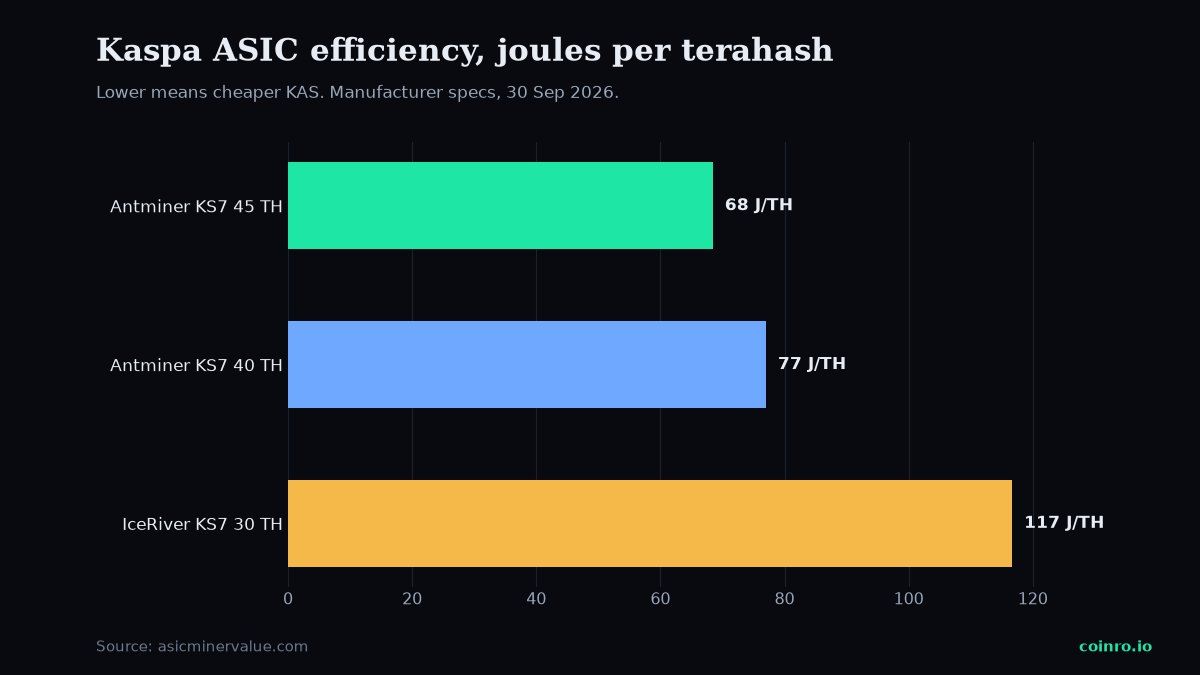
Efficiency decides who survives the next cut. Watch joules per terahash (J/TH) more than raw hashrate.
| Miner | Released | Hashrate | Power | Efficiency | Street price |
|---|---|---|---|---|---|
| Bitmain Antminer KS7 | Jan 2026 | 45 TH/s | 3,080 W | 68 J/TH | not listed |
| Bitmain Antminer KS7 | May 2025 | 40 TH/s | 3,080 W | 77 J/TH | $1,699 |
| IceRiver KS7 | Apr 2025 | 30 TH/s | 3,500 W | 117 J/TH | $2,199 to $2,496 |
Source: asicminervalue.com listings read on 30 Sep 2026. The IceRiver unit draws more power for less hash, so it goes negative first when power gets expensive.
One caveat on the newest row. The 45 TH page shows 3,080 W, but its own 0.077 J/Gh efficiency field implies about 3,465 W. Treat 68 J/TH as the best case and check the wall draw if you buy one.
Worked example: one KS7 40 TH at home
You buy an Antminer KS7 40 TH for $1,699 and pay $0.10/kWh. At today’s network size it mines about 214 KAS a day, worth about $9.35.
It burns 73.9 kWh, which costs $7.39. That leaves about $1.95 a day, or $60 a month, before any difficulty growth.
Payback on $1,699 at that pace is over 28 months. Add the monthly emission cut and 3% monthly difficulty growth, and the machine turns unprofitable in its fourth month. It never pays back.
Drop the power price to $0.06 and the same machine clears about $4.90 a day. That is still not enough to pay back within 24 months at 3% monthly difficulty growth.
What the monthly emission cut does to your income
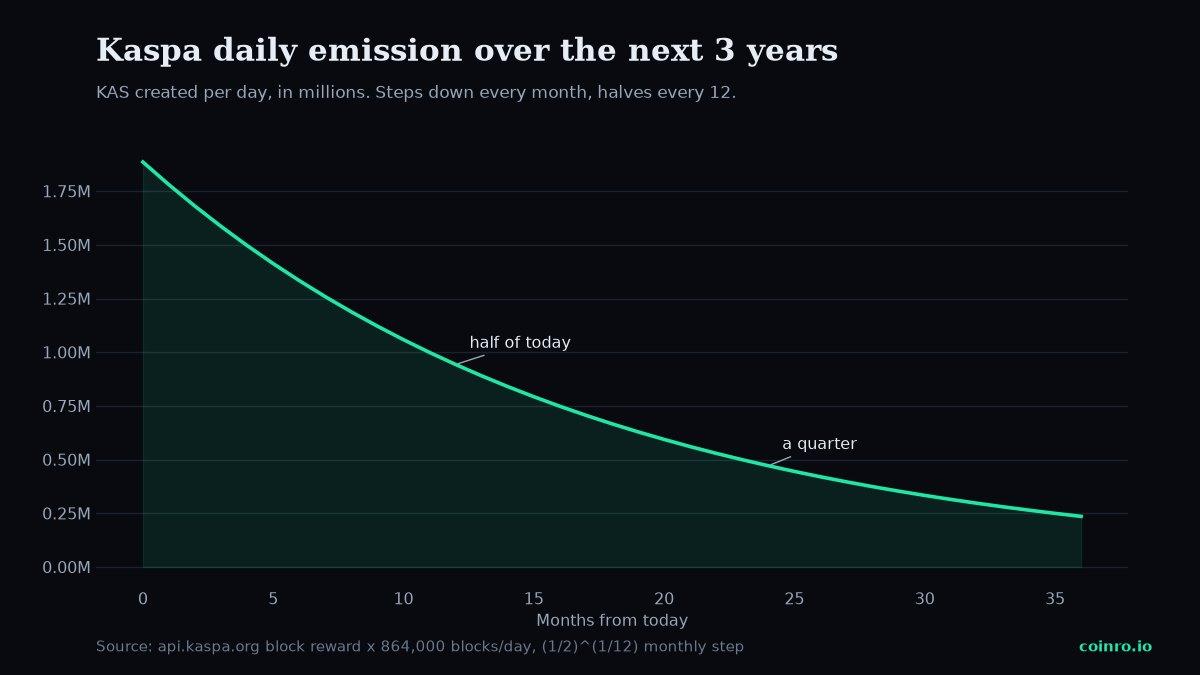
Most chains halve once every few years. Kaspa smooths its halving into 12 monthly steps, each one about 5.6% smaller than the last.
So a miner who earns 240 KAS a day today earns about 120 a day twelve months from now, even with zero new hashrate on the network. The calculator bakes this in.
Works for you
- Rewards land every second, so pool payouts are smooth
- Three live APIs make the numbers checkable
- A KAS price rally lifts every miner at once
Works against you
- Revenue in KAS falls every month by design
- New Bitmain models keep raising difficulty
- Older 100+ J/TH units have short useful lives
How to start mining Kaspa
- Price your power first. Find your all-in rate per kWh on your utility bill. Run it through the calculator before you buy anything.
- Buy an efficient ASIC. Aim for under 80 J/TH. Buy from the manufacturer or a known reseller, and budget for a 240 V circuit.
- Create a KAS wallet. Use the official Kaspa-NG wallet or a hardware wallet that supports KAS. Write down the seed offline.
- Pick a pool. Compare fees and payout thresholds on miningpoolstats.stream/kaspa. Spread across pools to avoid centralising the network.
- Point the miner. Enter the pool stratum URL and your wallet address in the miner’s web panel. Check the pool dashboard after 30 minutes.
asicminervalue lists the KS7 at 75 dB, and it turns about 3 kW into heat around the clock. Plan the room and the circuit before the purchase.
Risks to price in
ASIC resale value collapses when a more efficient model ships. The 45 TH KS7 already undercuts the 40 TH version you might buy today.
KAS price can fall faster than the emission. The calculator holds price flat, so stress-test it by typing a lower price.
Kaspa mining videos worth watching
Kaspa mining FAQ
Is Kaspa mining profitable in 2026?
It depends on your power price. A 45 TH KS7 nets about $4.60 a day at $0.08/kWh at today’s price, before hardware cost. At the US residential average of about $0.17 it loses about $2 a day, and the monthly emission cut makes both numbers worse over time.
Can I mine Kaspa with a GPU?
A GPU can run the algorithm, but its hashrate is measured in megahashes or low gigahashes, against 45 TH/s for one KS7. Its share of the network is close to zero. Type your card’s hashrate into the calculator to see the revenue, then subtract electricity.
How much KAS does a KS7 mine per day?
About 240 KAS a day for the 45 TH model at today’s network hashrate, after a 1% pool fee. The 40 TH model mines about 214. Both numbers fall every month as emission steps down, so multiply by your KAS price and project forward with the calculator.
When is the next Kaspa halving?
There is no single halving date. Kaspa cuts its reward by about 5.6% every month, and the cuts compound to half the emission over each 12 months. The calculator applies that step from month one, so projected income falls even when hashrate and price stay flat.
Which Kaspa pool has the lowest fees?
Fees differ by pool, so compare them on miningpoolstats.stream/kaspa before you point a miner. Payout threshold and uptime matter as much as the headline fee, because a pool with poor uptime can cost you more than a point of fee. The calculator assumes 1% and lets you set it to 0.
More mining and staking calculators
Estimates only, not financial advice. Mining revenue depends on network difficulty, coin price, pool luck and uptime, all of which change daily. Hardware specs are manufacturer figures as listed on asicminervalue.com.