Pearl (PRL) Mining Calculator: Can Your GPU Beat the Difficulty?
Pick a GPU, choose owned or rented, enter your power price. The calculator reads Pearl’s live difficulty and PRL price, applies the decaying block reward, and shows when the rig stops paying.

Pearl GPU profit calculator
loading live dataAssumptions: PRL per day equals your Th/s times 0.0224 at difficulty 33.09M and a 2,295.55 PRL block. It scales inversely with difficulty and in proportion to the block reward. Blocks arrive at the 194 second target. The reward follows the pearld formula and difficulty grows by the monthly rate you set. The PRL price stays flat. With NOCK merge mining on, NOCK follows the Aletheia reward schedule and its network hashrate grows at the same monthly rate as difficulty, and the NOCK price also stays flat. The miner switches off in any month it would lose money. Pool luck, downtime, fees on the exchange and resale value are ignored.
How Pearl mining pays you
Pearl is its own Layer 1, forked from Bitcoin’s btcd codebase, with mainnet live since 27 April 2026. Miners prove work by running int8 matrix multiplications on a GPU. The finder of each block collects the reward plus transaction fees.
Your share of daily emission equals your hashrate divided by the network’s. At 300 Th/s against roughly 45 EH/s you hold about 0.0007% of the network, which is about 6.7 PRL a day before fees.
That 6.7 figure rests on a rule of thumb from hashrate.no: 0.0224 PRL per Th/s per day at difficulty 33.09M.
I cross-checked it against the chain. At the 194 second target, about 445 blocks a day times 2,295 PRL is 1.02M PRL. Divided by the 45.3 EH/s 2miners reports, that gives 0.0226, within 1%.
Pearl hashrate by GPU
Pearl rewards int8 matrix throughput, so newer cards pull ahead fast. GTX 10 and 16 series cards and the V100 cannot mine it at all, because the rank-128 rules need RTX 20 series hardware or newer.
| GPU | Hashrate | Power | PRL per day | Net $/day | Source |
|---|---|---|---|---|---|
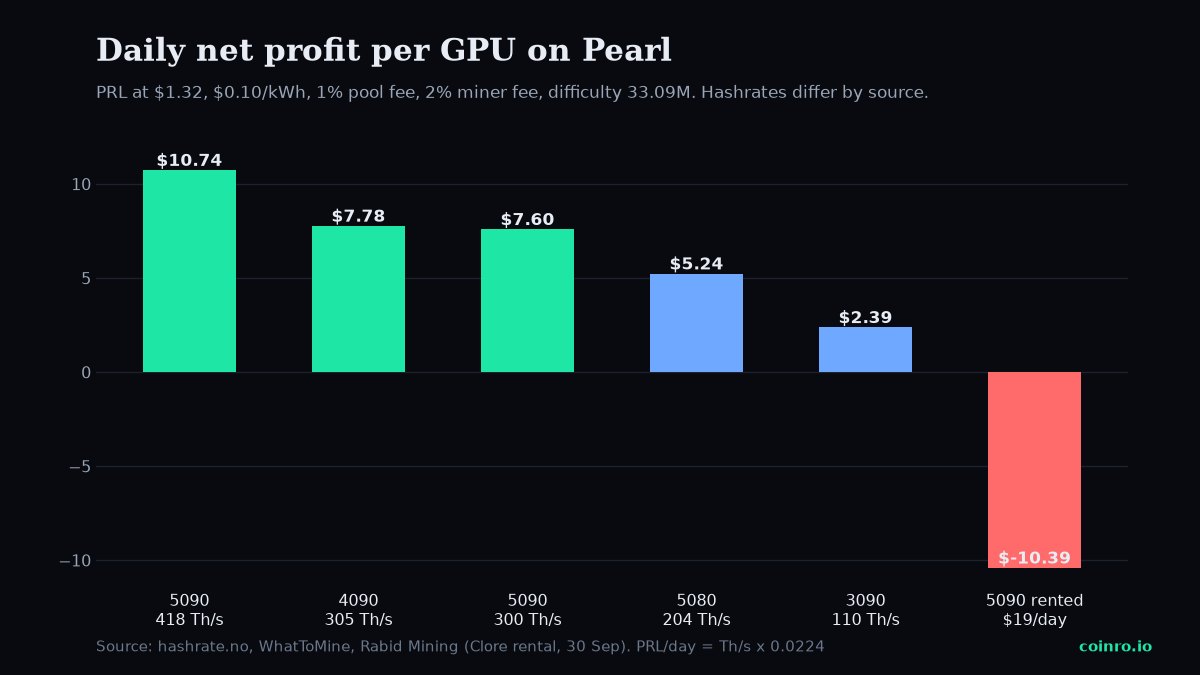
| RTX 5090 | 417.9 Th/s | 519 W | 9.36 | $10.74 | hashrate.no |
| RTX 5090 | 300 Th/s | 420 W | 6.72 | $7.60 | WhatToMine |
| RTX 4090 | 304.6 Th/s | 400 W | 6.82 | $7.78 | hashrate.no, power from WhatToMine |
| RTX 5080 | 203.6 Th/s | 250 W | 4.56 | $5.24 | hashrate.no, power from WhatToMine |
| RTX 3090 | 110 Th/s | 320 W | 2.46 | $2.39 | hashrate.no, power from WhatToMine |
| B200 (one farm) | 3,806 Th/s | 1,000 W | 85.3 | $106.77 | Rabid Mining: 201 GPUs, 765+ PH/s, 201 kW |
| H100 / H200 | unknown | unknown | n/a | n/a | No sourced per-card figure |
Net $/day assumes PRL at $1.32, $0.10/kWh, a 1% pool fee, a 2% miner fee and difficulty 33.09M. The B200 row divides one farm’s total by its GPU count, so read it as an average. For H100 and H200 I found no published Th/s, so type your own.
Why three Pearl calculators give three answers
Ask three sites what an RTX 5090 earns on Pearl and you get three different numbers on the same day.
| Source | 5090 hashrate | Power | Daily revenue |
|---|---|---|---|
| hashrate.no benchmarks | 417.9 Th/s | ~519 W | 9.36 PRL, about $12.5 at $1.34 (derived) |
| WhatToMine | 300 Th/s | 420 W | $8.12 |
| Rabid Mining | not shown, implies about 265 Th/s | 420 W | 5.94 PRL, $7.54 |
| This calculator, default | 300 Th/s | 420 W | 6.72 PRL, $8.87 at $1.32, before fees |
The hashrate input is the main driver.
The 5090 figure ranges from about 265 to 418 Th/s, a 58% spread, and revenue scales one to one with it. I could not find how hashrate.no collects its number, so I cannot say whether it reflects overclocked cards or a best-case kernel.
The network side differs too. On the same day, miningpoolstats put Pearl at 42.9 EH/s, 2miners at 45.3 and WhatToMine at 50.3, a 17% gap that moves every per-GPU estimate.
Timing matters as well. Tom’s Hardware, via Yahoo, reported a 5090’s estimated daily revenue falling from $33.80 to $17.19 within weeks as difficulty climbed. A screenshot of any calculator is stale within days.
Worked examples: an owned 5090 and a rented one
You run a 5090 at 300 Th/s and 420 W, pay $0.10/kWh, use a 1% pool and a 2% miner. Difficulty is 33.09M and PRL is $1.32.
It mines 6.52 PRL a day, worth $8.61. Power is 10.08 kWh, or $1.01, so you keep $7.60 a day, about $231 a month.
Now add 10% monthly difficulty growth and the reward decay. By month 12 the same card mines 1.51 PRL a day and nets $0.98. Twelve months at a flat $1.32 total about $1,233.
Same card, same network, rented at $19 a day. Revenue is still $8.61, so you lose $10.39 every day.
You need PRL at about $2.91 to break even.
At Vast.ai’s May median of $1.20 an hour the bill is $28.80 a day and the break-even price is above $4. Rabid Mining’s 30 Sep read matches this: hosting the GPU out for AI work paid more than mining on it.
Price is the swing factor for owners. At $0.56, where PRL sat on 15 September, the owned 5090 nets $2.64 a day.
At $0.23, the 22 July low, it nets $0.49. At $0.20 per kWh the day-one profit falls to $6.59.
The block reward decay Pearl uses instead of halvings
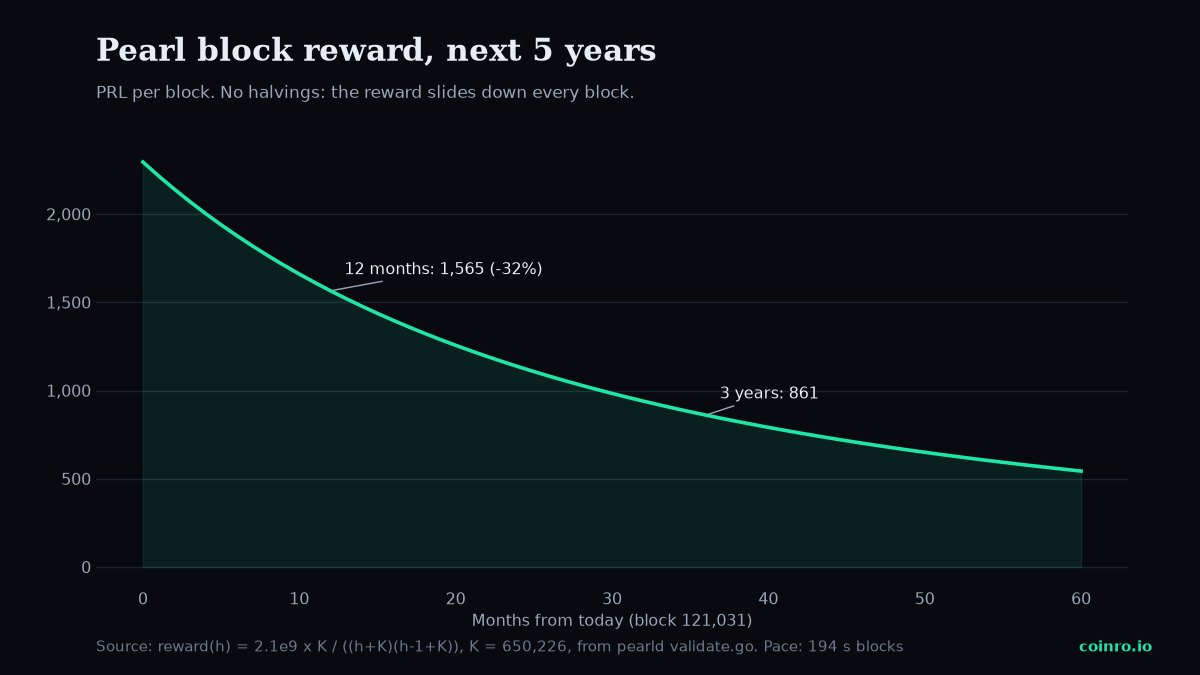
Pearl has no halving. The reward is 2.1 billion times K divided by (h + K)(h – 1 + K), where h is block height and K is 650,226. I checked it numerically: it gives 2,295.55 PRL at block 121,031, exactly the reward WhatToMine lists at that height.
The formula paid about 3,230 PRL at block 1. It pays 32% less twelve months from now, even if difficulty stood still.
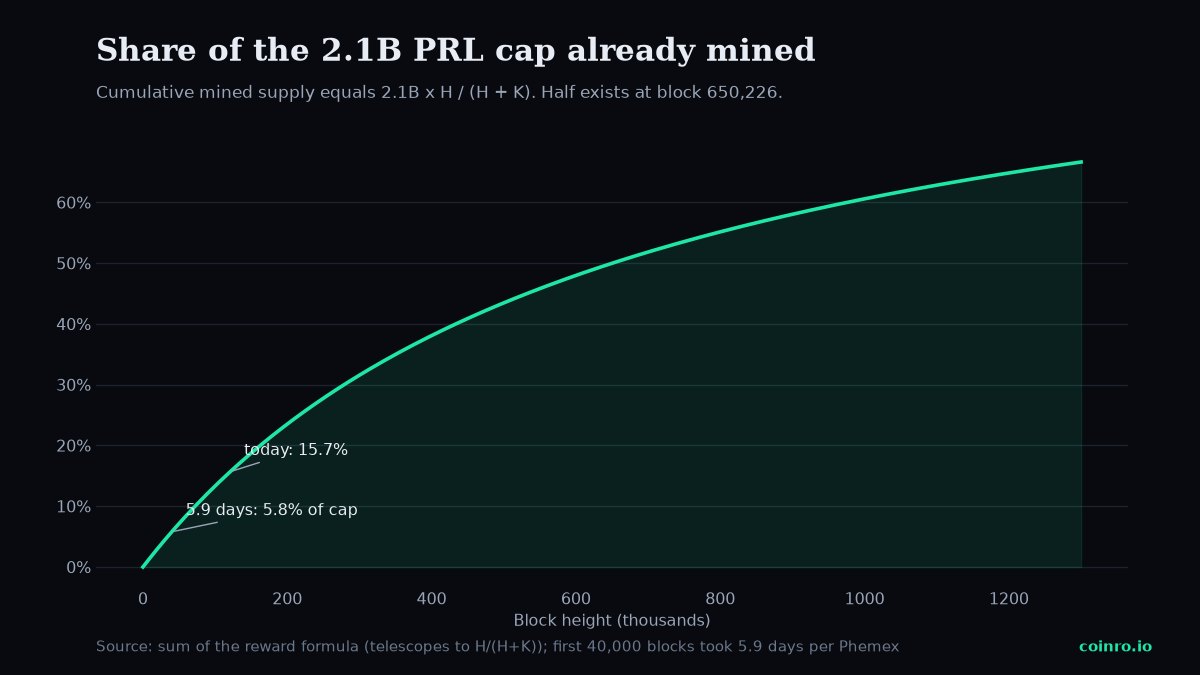
Cumulative supply works out to 2.1 billion times h divided by (h + K), so half exists at block 650,226, about 3.3 years away at the target pace.
Works for you
- A 5090 clears its power bill at normal electricity prices
- Pools range from 0% to 2% in fees
- Consumer cards from RTX 20 series up can mine
Works against you
- Difficulty rose about 55% in two weeks
- Block reward drops about 3.4% every month
- Renting GPUs to mine loses money today
What “useful work” means on Pearl
Pearl’s pitch is that the same GPU pass that serves an AI inference request also produces the proof of work. The team calls it 2-for-1 and claims near-zero overhead. The official miner is a vLLM plugin that only supports H100 and H200 (sm90) cards.
Consumer GPU miners run community software instead. On a 5090 at home there is no AI customer, so you are mining plain proof of work whose math happens to be matrix multiplication.
A 3 June arXiv preprint (2606.04819, single author Abhinaba Basu, under review) claims Pearl’s 24 EH/s network at the time, about 320,000 GPU equivalents and 112 MW, produced zero useful AI computation, because the verifier accepts random int8 matrices by design. Read it on arxiv.org; Tom’s Hardware covered it.
Pearl Research Labs answered on 8 June by citing a Rafael Pass paper on security budgets. It shipped a hard fork on 12 June and announced a floating-point scheme for Blackwell on 14 September.
Alea Research’s read is that one block reward goes to whoever finds the block, with no on-chain split between useful work and security and no on-chain marketplace yet.
My position: model your income as block rewards only. Inference fees are off-chain, separate and unproven for home miners.
How to start mining Pearl
- Check your card. RTX 20 series or newer. GTX 10, GTX 16 and V100 do not work. The official miner takes only H100 and H200.
- Create a wallet. Addresses start with prl1. Kryptex publishes a Pearl wallet guide.
- Pick a community miner. PeakMiner charges 2% and SRBMiner-Multi 3%. Update whenever a hard fork lands, or your shares get rejected.
- Pick a pool. On 29 Sep, Kryptex ran 22.9 EH/s at 2% PPS+, pearlhash 14.5 EH/s at 1% and HeroMiners 7.5 EH/s at 0% with MDL merge mining. LuckyPool pairs Pearl with NOCK at 1%. Current numbers sit on miningpoolstats.
- Plan the exit. Decide where you will sell before you mine, because liquidity is thin.
At least three different assets share the PRL name. Perle (PRL) is an unrelated coin, and a Base-chain “Pearl Research” token lookalike trades on Coinbase with about a $20K market cap. CoinMarketCap also has a Pearl page showing $1.30 on $72 of daily volume.
The live price in this calculator uses CoinGecko id pearl-2. Match that id before you trust any chart or buy anything.
Merge-mine NOCK on LuckyPool
LuckyPool pays NOCK, the Nockchain coin, on top of PRL from the same hashrate. You enter your Pearl address, a plus sign and a native NOCK address, and your miner has to support merge mining.
At 300 Th/s, switching the option on adds about $0.18 a day, roughly 2% on top of the PRL revenue. The NOCK miner reward then drops 25% at block 170,501, about 27 days after 30 Sep.
The add-on assumes your Pearl hashrate counts in full on NOCK. LuckyPool does not publish how it credits NOCK shares, so treat the figure as an upper bound.
The Nockchain mining calculator covers the NOCK reward schedule, the standalone maths and what is still unproven about counting Pearl hashrate on NOCK.
Risks to price in
Difficulty went from about 21.4M on 15 September to 33.09M on 30 September, which is 55% in two weeks. Every 10% jump cuts your PRL per day by about 9%.
Liquidity is thin. Volume was $3.17M against a $435.6M market cap, roughly 70% on SafeTrade, 29% on BigONE and a sliver on CoinEx. I found no Binance, Coinbase or Kraken listing for the L1 coin.
Early miners hold a large overhang. Launch difficulty started at 1, and the first 5.9 days produced 38.9% of everything mined by mid September. The fully diluted value is $2.78B against a $435.6M market cap.
Price has swung from $0.23 in July to $1.76 at its high, with a 30 day gain of 392%. Datacenter B200 farms are arriving, and the Blackwell floating-point upgrade has no activation date, so its effect on consumer cards is unknown.
Discord scams circulate around Pearl wallets. Download miners from the links above only.
Pearl mining videos worth watching
Pearl mining FAQ
Is Pearl mining profitable?
For an owned RTX 5090 at $0.10/kWh, yes: about $7.60 a day at $1.32 per PRL. Renting a GPU to mine loses money today. Difficulty growth and the falling reward shrink profit each month, so run the projection rather than the day-one number.
What GPU do you need to mine Pearl?
An NVIDIA RTX 20 series card or newer with a community miner such as PeakMiner. The official miner supports only H100 and H200. GTX 10 and 16 series cards and the V100 cannot mine Pearl because the rank-128 rules need newer kernels.
How many PRL does an RTX 5090 mine per day?
Between about 6 and 9 PRL before fees, depending on whose hashrate you trust. At 300 Th/s the rule of 0.0224 PRL per Th/s gives 6.72 PRL, and 417.9 Th/s gives 9.36. Higher difficulty cuts both numbers in proportion, so check the current value first.
Is Pearl’s useful work real AI work?
Partly unproven. The protocol can pair mining with inference, but the official miner supports only H100 and H200, and an unreviewed June arXiv preprint argues the verifier accepts random matrices. Model your income from block rewards alone, not inference fees.
Does Pearl have halvings?
No. The reward falls smoothly with every block using a fixed formula, and half of the 2.1 billion supply exists by block 650,226. That is about 3.3 years away at the 194 second target, and the reward is 32% lower in 12 months.
More mining and staking calculators
Comparing Pearl with another coin? Run your rig’s cost through the crypto ROI calculator, or compare mining with the staking yield calculator.
Estimates only, not financial advice. Mining revenue depends on network difficulty, coin price, pool luck and uptime, all of which change daily. GPU hashrates are community figures from hashrate.no and WhatToMine and differ from each other. Pearl (PRL) is a thinly traded asset, and the arXiv preprint cited here has not been peer reviewed.