NetNet Capital Staking Calculator: Will the Premium Pay You?
Enter what you invest, how you buy and where you think the premium to backing ends up. The calculator recomputes the NetNet Capital dividend rate every 8 hours and shows your position in dollars after the 5% levy, not in NET units.

NetNet Capital staking calculator
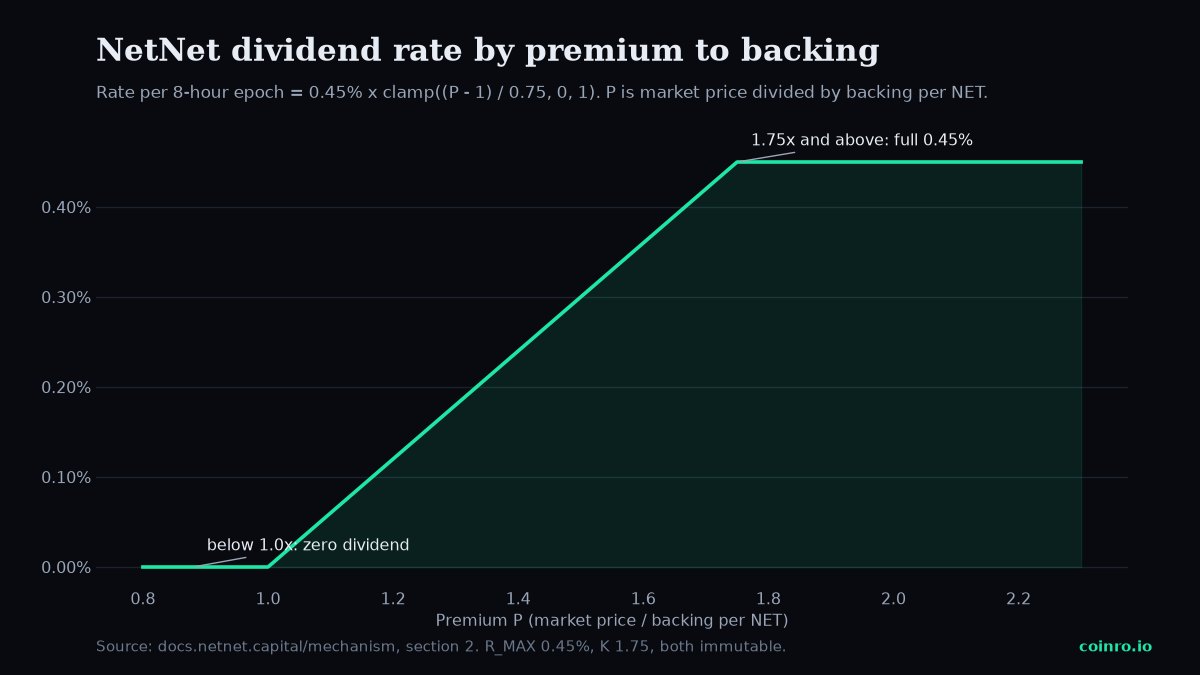
loading live dataAssumptions: the rate is recomputed every 8-hour epoch from the formula rate = 0.45% x clamp((P – 1) / 0.75, 0, 1), with P moving in a straight line from today’s premium to your exit premium. Dividends pay in NET units and compound. Backing per NET falls by the share of each dividend you mark as not refilled, scaled by the 92.5% of supply that is staked, and rises by your reserve growth input. Bonds vest in six equal epoch steps and start earning as they vest. The sell levy is taken at exit, pool price impact is shown but not deducted, and pTEAM exercises, premium sales and taxes are ignored. Your hold-USDG comparison earns nothing.
How NetNet Capital pays stakers
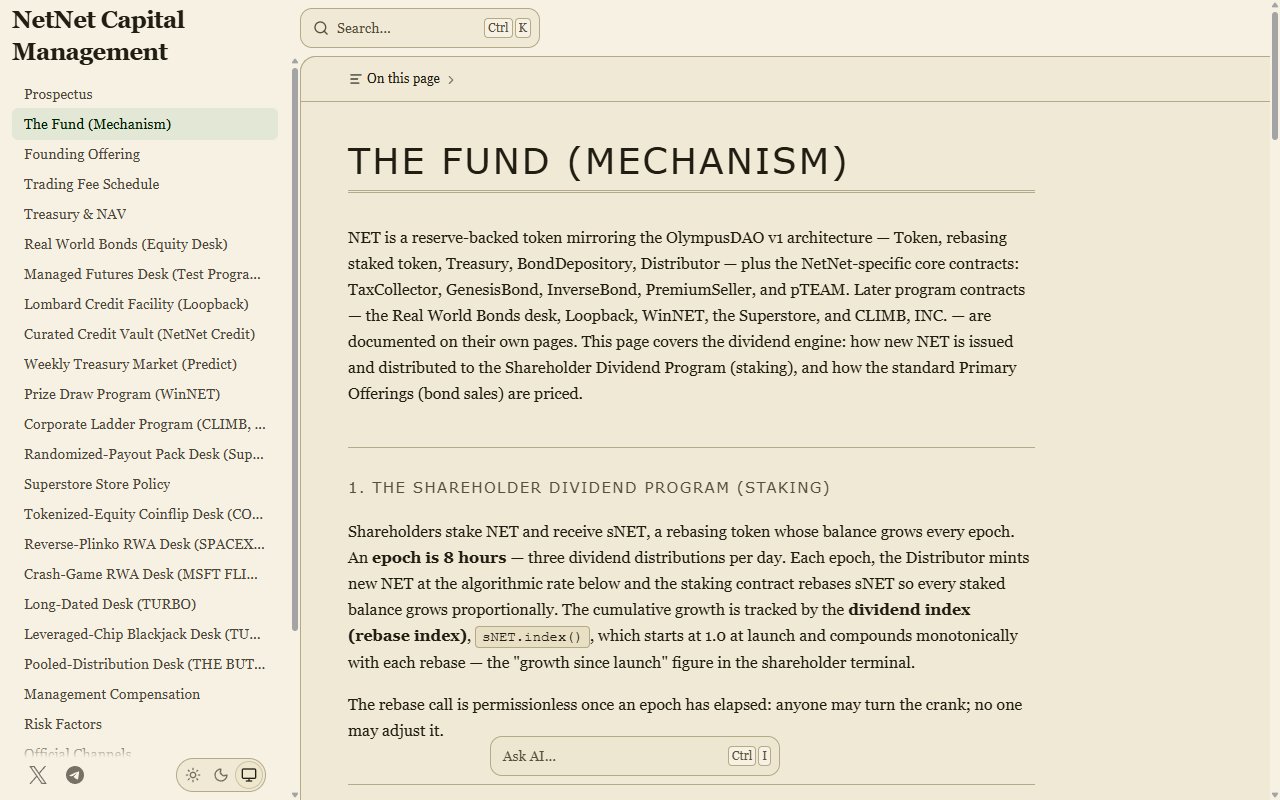
NET launched on 16 Jul 2026 on Robinhood Chain as a reserve-backed token. You stake it, receive sNET, and your balance grows automatically three times a day.
The growth is new NET minted each 8-hour epoch. The rate depends on one number, the premium P, which is the market price divided by the backing per NET.
Below a premium of 1.0x the rate is zero. At 1.75x and above it is 0.45% per epoch. In between it rises in a straight line.
The price feeding the formula is a time-weighted average from the canonical Uniswap v2 NET/USDG pool. If that oracle goes stale for more than four hours, the distributor skips the epoch and nobody earns until someone refreshes it.
The contract design is OlympusDAO v1. Unlike Olympus, the mechanism page says NetNet has no debt-ratio controller and no policy levers, so this one curve is the whole dividend policy.
What the 13,551% APY really measures
The app shows a 13,551% annual figure next to the staking desk. It is arithmetic: 0.45% compounded over 1,095 epochs. It counts NET units, and the docs say so in capitals: the APY compounds in NET and says nothing about the USDG price of NET.
At the full rate your balance multiplies by roughly 1.5 every month. Everyone else staking gets the same multiple, so the price per NET has to absorb a supply that grows roughly 45% a month.
Dividends mint NET without bringing in a single dollar, so backing per NET falls with every rebase unless buyers and bonds refill the reserve. The docs list the epoch mint as one of only two operations allowed to lower backing per NET.
Use the dilution slider to see both worlds. At 0% you assume new money covers every dividend. At 100% reserves never grow, and a staker who sees the premium hold still ends the period roughly where they started in dollars.
Market buy or bond: which route costs less
Buying on Uniswap costs the quoted price plus a 5% levy, so 456.99 becomes 481.04 all-in. The Real World Bond desk sells NET at a 6.5% discount to the TWAP with no levy. Against the market route the docs put that advantage at about 11.2%.
| Route | Entry price at 456.99 | Levy | Vesting | Limits |
|---|---|---|---|---|
| Market buy | 481.04 all-in | 5% | none | Pool depth, about $550K |
| Real World Bond | about 427.29 | none | 2-day linear | 150 NET inventory at launch, desk halts below 1.2x high-water backing |
| Standard bond | TWAP x (1 – discount), floor at backing | none | not printed | Discount and epoch capacity not printed in the docs we read |
Source: docs.netnet.capital /rwa-desk and /FEES.HTM. The bond price uses the TWAP, which can differ from the live price you see. The bond NET comes from the team’s pre-exercised allocation, not from a fresh mint.
The bond is cheaper, but your USDG is split. About 6% goes to the treasury as a fee the docs call backing-neutral, and about 94% buys a tokenized stock for a team-custodied sleeve that sits outside the backing figure.
The exit side has no bond. Every sale on the main pool pays the 5% levy again, and the buy plus the sell costs about 10%: $10,000 in and straight back out returns $9,025.
Worked example: $10,000 at today’s price
You market-buy $10,000 of NET at 456.99 with backing at 173.96. The levy leaves you 20.788 NET. You stake for 90 days and the premium drifts from 2.63x down to 2.0x, so the rate stays at its 0.45% maximum throughout.
Your balance grows to 69.872 NET, a 236% gain in units. With backing flat, the price at exit is 347.92. You sell, pay the 5% levy, and receive $23,094. Profit against holding USDG: $13,094.
Now remove the assumption that new money refills the reserve. Backing slides to 56.67, the price at 2.0x is 113.34, and the same 69.872 NET sells for $7,524. You lose $2,476 on identical unit growth.
Neither figure counts slippage. The 66 NET you push through the pool on exit are about 11% of the NET it holds today.
Flat backing with the premium falling to 1.0x returns $8,714, a loss of $1,286. With flat backing you break even at a 1.09x exit premium. With no new reserves you need 2.66x, which is slightly above where NET trades today.
Compare the result with a plain yield in the staking yield calculator, or log the trade in the crypto ROI calculator once you close it.
Works for you
- Formula and constants are public and immutable, so the rate is checkable
- Bond route skips the 5% levy on entry
- A rising premium raises units and price together
Works against you
- Rate hits zero if the premium falls to backing
- Dividends dilute backing unless new money arrives
- Round trip through the levy costs about 10%
How to stake NET
- Open the official app. Go to app.netnet.capital, the address listed on the project’s official channels page, and connect a wallet on Robinhood Chain.
- Fund with USDG. Both the market buy and the bond are paid in USDG. Check the pool impact row in the calculator before a large order.
- Choose your route. Use the Buy NET tab for a market buy with the levy, or the Bond tab if the desk has inventory.
- Stake on the Stake tab. You receive sNET. The desk describes it as earning every 8 hours, and your sNET balance rises at each rebase.
- Plan the exit first. Unstaking is free, but selling on the main pool pays the levy and moves a thin price. Decide your size before you enter.
NetNet Capital risks you should price in
We found no audit report in the docs, on the site, or in search. The docs cite only an internal invariant test suite, and the contracts are immutable, so a bug cannot be patched.
The pTEAM management option lets the team mint up to 15% of circulating supply at 1 USDG per NET, against a backing near 174. It never expires and the cap grows with supply, so the team can exercise again after every dividend.
The Safe that controls the fee map and holds pTEAM is set to 1-of-1, one hardware wallet, and the docs admit it is below their own 2-of-3 recommendation.
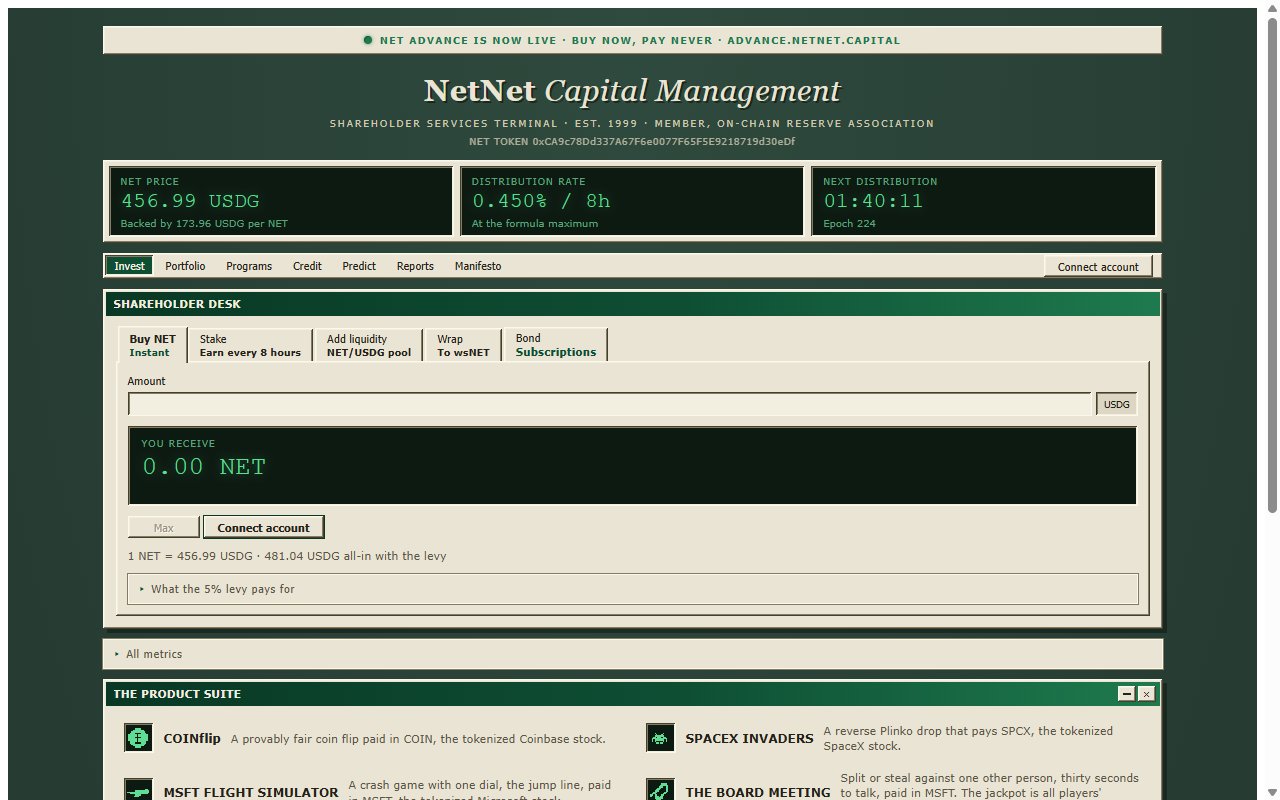
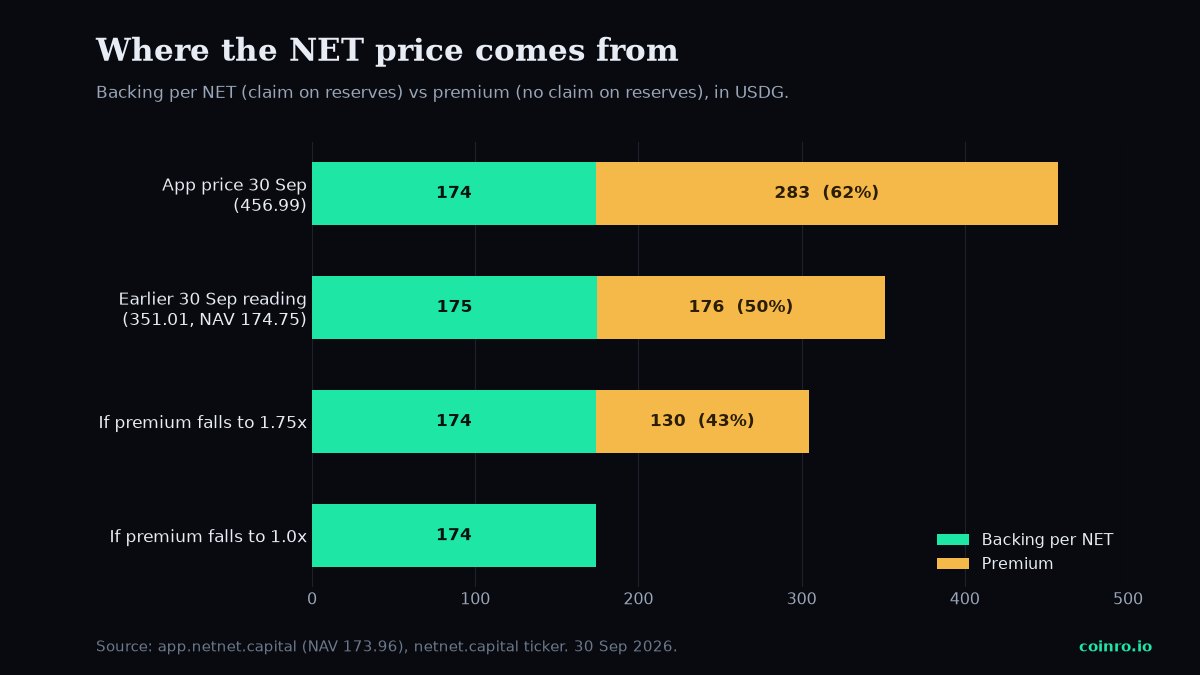
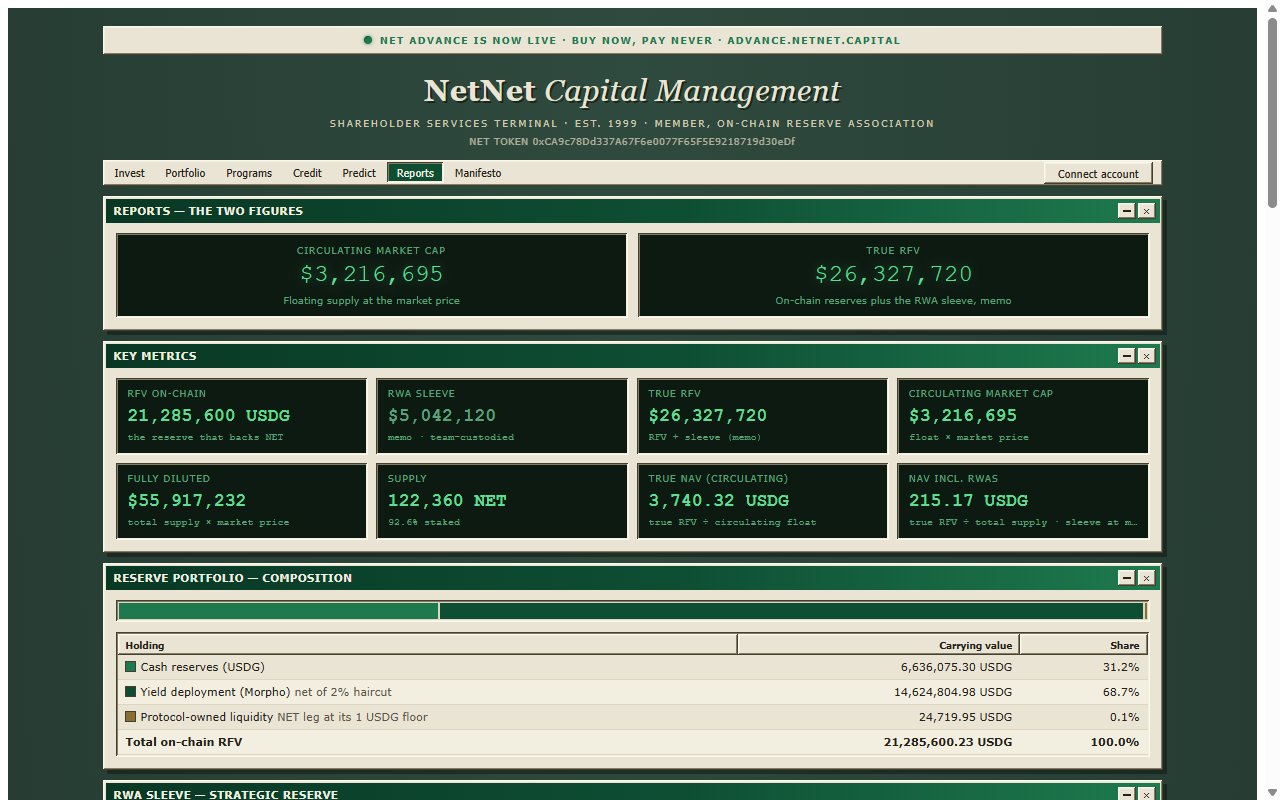
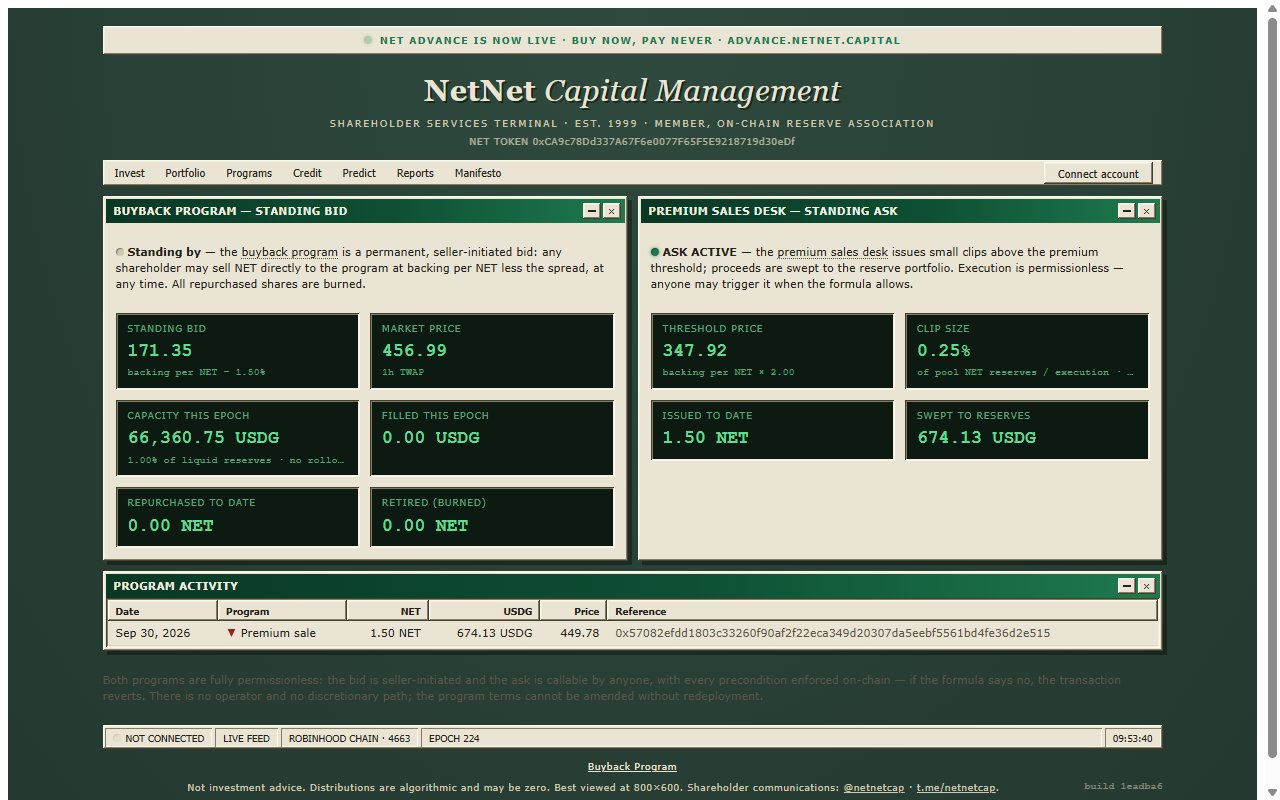
About 62% of the price is premium with no claim on reserves. Below 1.0x the dividend is zero, and the standing buyback bid sits at 171.35, far below the market.
Over 92% of supply is staked, so the float is tiny: circulating market cap is about $3.2M and the pool holds roughly $550K. A $10,000 exit moves the price, and the 5% levy applies on top.
68.7% of the $21.3M on-chain reserve sits in Morpho, and the docs state that their 2% haircut does not price a loss event. The premium desk also mints and sells small clips of new NET whenever the TWAP is above 2.0x backing.
The project calls itself a parody and says distributions may be zero. It also runs games of chance on the same token, with regulatory status unknown to us. Treat any position as capital you can lose.
NetNet Capital videos worth watching
NetNet Capital FAQ
What is NetNet Capital (NET)?
NET is a reserve-backed, rebasing token on Robinhood Chain that launched on 16 Jul 2026. It copies the OlympusDAO v1 design. You stake NET for sNET, and new NET is minted to stakers every 8 hours when the price trades above backing.
Is the 13,551% APY real?
It is the correct arithmetic for 0.45% compounded 1,095 times, but it counts NET units, not dollars. It assumes the premium holds for a year and backing never dilutes. Dollar returns depend on the NET price, which has to absorb the growing supply.
What happens to rewards if the premium drops?
The rate falls in a straight line between 1.75x and 1.0x backing, and it is zero at or below 1.0x. At 1.5x you earn 0.30% per epoch. At 1.0x you earn nothing while the extra supply already minted stays in circulation.
How much does it cost to buy and sell NET?
The token charges a 5% levy on every buy and sell through the main Uniswap pool, so a round trip loses about 10% before slippage. Bonds skip the levy on entry. Wallet-to-wallet transfers and staking are free, but a thin pool adds slippage on larger exits.
Has NetNet Capital been audited?
We found no audit report in the docs, the site or search as of 30 Sep 2026. The docs cite an internal invariant test suite. The contracts are immutable, so any bug stays, and the docs themselves call that an immutable bug. Treat the code as unaudited.
More mining and staking calculators
Estimates only, not financial advice. NET is a high-risk token with no audit we could find. Figures are read from app.netnet.capital, docs.netnet.capital and DexScreener on 30 Sep 2026 and move hourly. The premium path, dilution and reserve growth are your assumptions, not forecasts.