TAO Staking and Bittensor Mining Calculator: What You Really Keep
Pick root or subnet alpha staking and the first calculator shows what you keep after validator take, slippage and an alpha price move. The second runs a miner on a real subnet, using what the chain paid its miners on 30 Sep 2026. Most mining slots earned nothing that day.

TAO staking calculator
loading live dataYuma-style: 9% take, 798k TAO on root. About 10.5% after take, derived from taostats on 30 Sep 2026.
Assumptions: net yield equals yield before take times one minus take, and stays constant for the whole period. Alpha yield is held constant in alpha terms. Slippage uses the constant-product formula x / (reserve + x) with the reserve you enter. A 0.05% swap fee applies on entry and exit on both routes (not confirmed for root). The alpha price change applies once, at exit, and TAO price stays flat. Unstaking delays, claim thresholds and tax are ignored.
Bittensor subnet mining calculator
loading live dataHardware is the midpoint of OpenTAO’s $4,000 to $8,000 a month bare-metal H100 range.
The default position is the average slot because that is what a new miner should expect to be averaged against. Switch to median or top and you are assuming you beat almost everyone already on the subnet.
Assumptions: income is gross alpha from one tempo snapshot (30 Sep 2026), priced at the alpha price you enter, before hardware, API and rent. You sell all alpha every day, paying slippage of sale / (reserve + sale) plus a 0.05% fee. Repeated selling would push the pool price down further, which this ignores. The chain shows income per miner hotkey, not per GPU, so the hardware field is yours to fill. Subnet deregistration and miner eviction are not modelled.
How TAO staking pays you
You stake TAO to a validator, and the validator passes on what it earns after taking a cut. Bittensor gives you two places to put the stake. Root (subnet 0) pays in TAO, while a subnet pays in its own alpha token.
Root dividends are subnet alpha swapped into TAO. The default is to swap and restake on root, so your balance compounds in TAO.
Alpha staking adds a second bet. You earn in alpha, and alpha trades against TAO in its own pool. Earn 24% while alpha falls 40% and you are down.
Only part of the daily emission reaches subnet pools. On 30 Sep 2026 the chain showed 0.1547 TAO per block injected across 130 subnets, about 31% of the 0.5. The docs route the rest to chain buys, and per-subnet totals for that share were not readable.
What TAO validators pay in 2026
Taostats has 1 day to 30 day APY columns, but the values sit behind an API key. The yields below are derived from the nominator return and stake fields on its validator page, as simple APR after take.
| Validator | Take | Root / alpha stake | Yield after take |
|---|---|---|---|
| Kraken | 18% | 858k / 17.6k TAO | 4.1% |
| Opentensor Foundation | 18% | 222k / 19.5k TAO | 5.7% |
| Yuma | 9% | 798k / 181k TAO | 10.5% |
| Taostats | 9% | 527k / 192k TAO | 13.3% |
| tao.bot | 0% | 1.01M / 378k TAO | 15.3% |
| Arbos | 0% | not read | 25.1% |
The median of the top 30 validators with more than 50k TAO staked is 9.4%, with a range of 4.1% to 28.6%. Source: taostats.io/yield, 30 Sep 2026, Coinro arithmetic.
Take is the lever you control. Kraken’s 18% leaves 4.1%, while tao.bot’s 0% leaves 15.3%. The higher yields also carry more alpha, so part of the payout depends on alpha prices.
To turn any of these yields into a dollar outcome for other coins, use the staking yield calculator.
Worked example: 100 TAO for 12 months
You stake 100 TAO on root with a 9% take validator paying 11.5% before take, compounding monthly.
That is 10.46% a year after take. Twelve months leaves you 10.9 TAO ahead, worth $3,283 at $302 per TAO, after 1.14 TAO of take and about 0.1 TAO of fees.
Put the same 100 TAO into Chutes alpha at 24.1% after take. If alpha holds its price you earn 26.7 TAO, and slippage plus fees on a 203,331 TAO pool cost only 0.24 TAO. Alpha matches root only if its price falls 12.5% over the year.
If alpha loses 40% instead, the stake ends at 76.0 TAO, a loss of 24.0 TAO ($7,237) while root made 10.9.
In a pool holding only 3,413 TAO, a flat price still costs 2.9% on entry and 3.5% on exit, which cuts the gain from 26.7 to 18.9 TAO.
What slippage costs you on subnet alpha
Every subnet pool prices alpha with a constant-product curve. Slippage is roughly your stake divided by the pool’s TAO reserve plus your stake, plus the 0.05% fee.
It hits twice, once going in and once coming out. On a large pool you will not notice. On a small one it decides the outcome.
| Pool | TAO in pool | Stake 100 TAO | Stake 1,000 TAO |
|---|---|---|---|
| Chutes SN64 | 203,331 | 0.05% | 0.49% |
| lium.io SN51 | 164,843 | 0.06% | 0.60% |
| Targon SN4 | 134,907 | 0.07% | 0.74% |
| A pool of about 1,000 TAO | 1,000 | 9.1% | 50.0% |
| Capcomp SN103 | 330 | 23.3% | 75.2% |
Pool reserves are from taostats on 30 Sep 2026. The 0.05% fee is excluded from the table. The SDK can estimate slippage before you submit and supports price protection, so use it on any subnet outside the top ten.
How Bittensor mining pays
Each subnet mints 1 alpha per block as participant emission, which is 7,200 alpha a day. Per tempo of 360 blocks, about 1.2 hours, 41% goes to miners, 41% to validators and their stakers, and 18% to the subnet owner.
That leaves 2,952 alpha a day for the miners of one subnet. Validators score the miners, and the score sets each miner’s share.
A subnet’s share of the TAO flowing into pools follows its average alpha price. That rule changed in November 2025 and again in June 2026, so anything older than June may describe a different system.
Burn data covers 125 emission-enabled subnets on 30 Sep 2026. Hardware and the weeks you spend tuning cost far more.
Who actually earns from Bittensor mining
We read the alpha paid to every miner UID on ten subnets and kept UIDs with incentive above zero and no validator permit. Values are USD at $301.66 per TAO and each subnet’s alpha price, from one tempo on 30 Sep 2026, all gross.
| Subnet | Earning miners | Median earner | Top miner | Average slot |
|---|---|---|---|---|
| Chutes SN64 | 16 of 238 | $2,179 | $12,245 | $215 |
| Targon SN4 | 3 of 244 | $11,604 | $32,638 | $193 |
| lium.io SN51 | 71 of 245 | $51 | $3,090 | $93 |
| Minos SN107 | 20 of 92 | $364 | $30,149 | $411 |
| KubeTEE SN90 | 2 of 92 | $9,015 | $10,944 | $196 |
| OpenRoboto SN80 | 6 of 243 | $1,013 | $3,115 | $32 |
| ORO SN15 | 83 of 244 | $14 | $19,911 | $86 |
| ChronoLLM SN38 | 10 of 249 | $448 | $9,451 | $73 |
| Ridges SN62 | 21 of 237 | $141 | $1,158 | $26 |
| engy SN53 | 62 of 238 | $1 | $8,007 | $73 |
Read the Chutes row first. Sixteen miners out of 238 slots earned anything, and the median of those 16 took $2,179 a day. Spread across every slot, the same pool pays an average of $215.
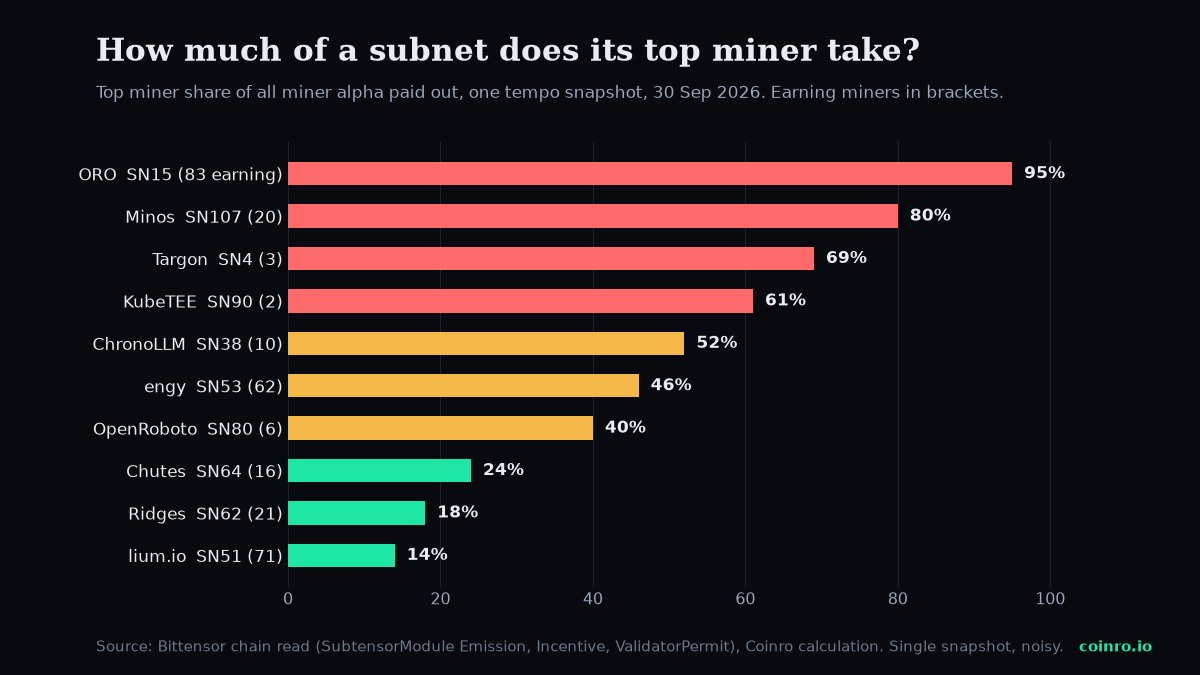
Two caveats apply. The chain shows income per hotkey, not per GPU, so a top miner may run many nodes and the chain does not say how many. One tempo is also a noisy sample.
Some YouTube income claims do not match the chain. A video titled “How Bittensor Miners Are Earning $50,000 Per Day in 2026” says the top Ridges miner makes $30,000 to $50,000 a day in tokens. The chain showed about $1,158 a day for that miner.
Top Bittensor subnets by TAO injected, and what a miner runs
The table ranks subnets by TAO injected into their pools per day on 30 Sep 2026, out of about 1,114 TAO a day in total. It skips SN80, because an older playbook says Scrypt ASICs while taostats now describes a robotics model competition.
| SN | Name | TAO a day | Share | What a miner does | Hardware listed |
|---|---|---|---|---|---|
| 51 | lium.io | 96.4 | 8.66% | Plugs GPU executors into a rental scheduler; uptime under live rentals drives score | H100, A100 or 4090 class, 80 GB VRAM |
| 107 | Minos | 95.6 | 8.59% | Runs a variant caller and submits a VCF scored by hap.py; 100 slots | 4 cores, 16 GB RAM, no GPU |
| 90 | KubeTEE | 95.0 | 8.53% | Resolves prediction-market statements with LLM fact-checking; flagged low activity | 2 cores, 4 GB VM, plus LLM API spend |
| 64 | Chutes | 68.8 | 6.18% | Serverless GPU inference on a K3s cluster with attestation | TDX-capable 80 GB GPU node, 16 CPU, 192 GB RAM |
| 15 | ORO | 53.1 | 4.77% | Writes Python shopping agents in a king-of-the-hill contest | Dev box, 4 cores, 16 GB RAM |
| 4 | Targon | 51.5 | 4.62% | Serves LLM inference in a confidential VM; emissions come from auctions | H100 or H200 with 5th-gen Xeon TDX, 256 GB RAM |
| 38 | ChronoLLM | 43.1 | 3.87% | Plays a rock-paper-scissors game through an EVM dApp; repo archived May 2026 | Wallet and browser |
Sources: chain SubnetTaoInEmission and the opentao.ai playbooks dated 30 May to 1 Jun 2026. SN3 is also left out. It was Covenant AI’s Templar until they exited in April 2026, and its current status is unclear.
Worked example: one rented H100 node on Chutes
You rent one bare-metal H100 node for Chutes at $200 a day, the midpoint of OpenTAO’s $4,000 to $8,000 a month range, and pay the 0.0005 TAO burn ($0.15).
The average SN64 slot earned 10.08 alpha a day, worth $215 at 0.0708 TAO per alpha and $302 per TAO.
That nets $15 a day, or $465 a month. With one month of tuning before income starts, you are $973 behind after 12 months and have not broken even.
A slot that earns nothing costs the full $200 a day, $6,088 a month.
A median earner at 102.1 alpha a day would net $1,980 a day, but only 16 of 238 slots earned anything, and the chain does not show how many GPUs sit behind each one.
The crypto ROI calculator can test the same buy-in against a different price path. The real unknown is the nodes-per-hotkey number, and the calculator leaves it to you.
The TAO halving and what it changes
TAO halved in December 2025, when issuance reached 10.5 million, cutting emission from 1 to 0.5 TAO per block. Press sources disagree on the exact day, from 10 to 15 December.
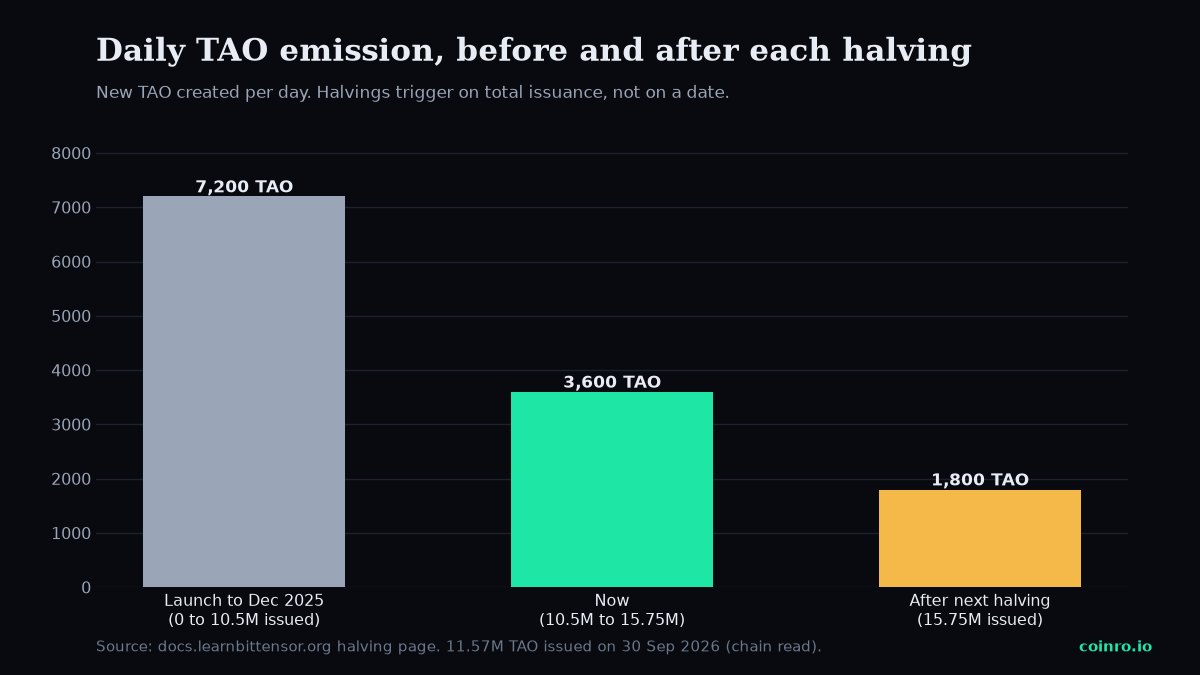
The chain showed 11,567,226 TAO issued. That leaves 4,182,774 to go, about 1,162 days at 3,600 a day, so late 2029 if nothing is recycled.
The docs say participant alpha rewards do not halve when TAO does. Only the TAO and alpha injected into pools halve. The alpha a miner earns per day is unchanged, but the TAO flowing into pools falls by half.
Works for you
- Root staking pays in TAO with no subnet to pick
- Big pools like Chutes cost under 0.1% to enter on 100 TAO
- Some subnets have no GPU requirement
- A 0% take validator keeps the full yield
Works against you
- Alpha yield falls with alpha price, and small pools cost 20%+ to exit
- Most mining slots earn nothing
- Emission rules changed twice in seven months
- Top subnets need attested hardware
How to start staking or mining on Bittensor
Staking
- Keep the coldkey safe. It controls all your TAO and alpha. Use a hardware wallet and never put it on a mining server.
- Choose by take and stake mix. Sort taostats.io/yield by take, then check how much of the stake is alpha.
- Start on root. The minimum is 0.1 TAO. Decide whether dividends swap to TAO or stay as alpha.
- Check slippage before a subnet stake. Enter the pool reserve in the calculator and look at the exit row, not only the entry.
Mining
- Read the subnet playbook. Hardware, attestation and scoring differ everywhere. A playbook from May may be out of date.
- Check the burn. btcli subnets show –netuid N prints the current registration price.
- Count earners first. If only 2 to 16 miners earn, plan for zero income for a while.
Risks to price in
Each new registration can evict the lowest-emission miner that is no longer immune. Immunity is a median 5,000 blocks, from 1 to 65,535 by subnet. You lose the UID and the burn, not your stake, and there is no appeal.
Chutes and Targon need attested hardware, and marketplace rentals such as Runpod and Vast are disallowed on Chutes.
When all 128 subnet slots are full, a new registration removes the lowest-priced non-immune subnet. Alpha holders get TAO from the pool pro rata, diluted by protocol-owned alpha. Taostats listed SN86, SN59, SN108 and SN82 at a price of zero on 30 Sep 2026, all still immune.
Sites including tao.media and subnetaiq.io put TAO down 18% to 27% within hours after Covenant AI left on 9 to 10 April 2026. We read only their search snippets, not the full articles. Validator take can also change, and emission rules have changed twice since November 2025.
Bittensor videos worth watching
Bittensor staking and mining FAQ
How much can you earn staking TAO?
On root, validators paid 4.1% to 13.3% after take on 30 Sep 2026, with a median of 9.4% across the top 30 by stake. Yields above that carry an alpha component, which can lose value against TAO. Check taostats.io/yield for live numbers before you pick.
Is root or alpha staking better?
Root pays in TAO, so the price of alpha does not matter. Alpha-heavy validators showed 19% to 25%, but you take alpha price risk and pay slippage twice. At the default settings here, alpha falling about 12.5% erases its advantage over a 10.5% root yield.
Is Bittensor mining profitable?
For a few miners, yes. On Chutes only 16 of 238 slots earned on 30 Sep 2026, and the average slot grossed $215 a day against about $200 a day of rent at the midpoint of OpenTAO’s range. Expect a loss until you rank among the earners.
When is the next TAO halving?
At 15.75 million TAO issued, which cuts emission from 3,600 to 1,800 TAO a day. About 11.57 million were issued on 30 Sep 2026, so the date is roughly late 2029 at the current pace. Registration burns are recycled and push it later.
How much does it cost to register a miner?
The burn ranged from 0.0005 to 1 TAO on 125 subnets, with a median of 0.02 TAO, about $6. Hardware costs far more. OpenTAO lists $4,000 to $12,000 a month to rent a bare-metal H100 node for Chutes or Targon.
More mining and staking calculators
Estimates only, not financial advice. Staking yields and miner income change every tempo, and alpha prices can move 20% in a week. Miner income here is gross alpha from one chain snapshot on 30 Sep 2026 and excludes hardware, API costs and taxes. Validator yields are derived from taostats page fields, not from a published APY.