Qubic Mining Calculator: What Does One it/s Pay Now?
Qubic (QUBIC) pays miners out of a fixed weekly emission of 1 trillion tokens, and since epoch 227 only 18.2% of that reaches the seats miners compete for. This calculator turns your iterations per second, power draw and electricity price into weekly profit, then shows the payout per it/s you need to break even.
Qubic profit calculator
loading live dataAssumptions: one epoch equals 7 days, electricity is billed at 168 hours a week, and the price stays flat at the value you enter. From epoch 279 the payout per it/s is multiplied by 125/240, the ratio of the two net emission figures in the Qubic docs, which the docs mark as approximate. The rig switches off in any week it would lose money. Pool luck, downtime, hardware cost and resale value are ignored.
The payout per it/s is the one input nobody can publish with confidence right now. QLI’s own Earnings page opens with “Estimates are currently NOT valid”, because the new algorithm weights each share differently.
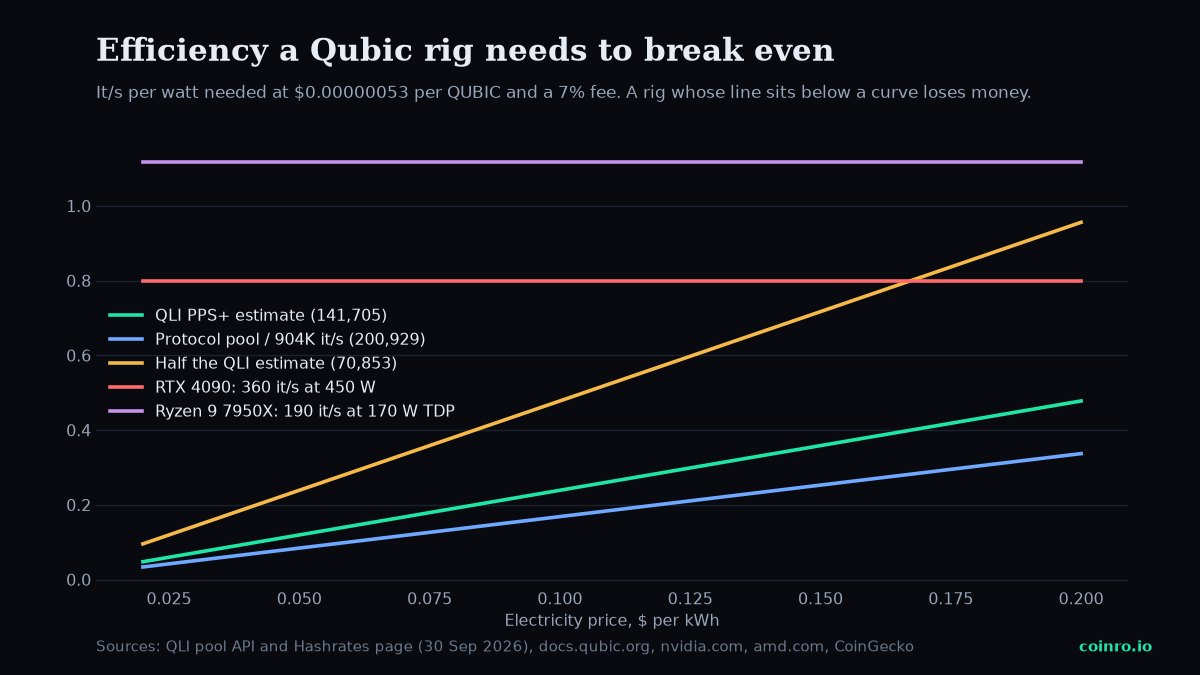
Use the break-even rows instead. They tell you what the payout must be for your rig to cover its power bill, and you can compare that with your pool dashboard after one full epoch.
What is Qubic, and why does it have miners?
Qubic is a layer-1 network where 676 validators, called computors, agree on state by quorum vote every tick. Transfers are feeless, and smart contracts are compiled into the node software instead of running in a virtual machine.
QUBIC is an energy unit. It is burned when contracts run or when a contract IPO auction clears, so computors never collect fees. The supply cap is 200 trillion, cut from 1,000 trillion by a community vote, and 177.6 trillion already circulate after 54.4 trillion burned.
Miners supply the work. Under useful proof of work they train small neural networks for Aigarth, Qubic’s open AI project, and the 676 best-scoring identities each epoch become the next computors.
The scoring changed twice this summer. BPP-9000 went live around epoch 224 and ranks a network by how well it predicts Bitcoin’s direction from a year of hourly data. Ant colony mining arrived at epoch 228, so miners now extend each other’s best results and the network harvests each miner’s single best one.
How does a Qubic miner actually get paid?
The protocol pays computors, and pools register your solutions under their own identities. Minerlab’s overview says rewards on an identity are split between its miners in proportion to contribution, in QUBIC, after the epoch closes.
So the pie is whatever reaches computors. Each epoch mints 1 trillion QUBIC, up to 77.5% is burned since epoch 227, and the Computor Controlled Fund and QEarn take their cuts from what is left.
| Per epoch | Epochs 175 to 226 | Epoch 227 onward |
|---|---|---|
| Gross emission | 1,000B | 1,000B |
| Maximum burn | 550B (55%) | 775B (77.5%) |
| Effective emission | 450B | 225B |
| Computor Controlled Fund (8%) | 36B | 18B |
| QEarn (12.25%) | 50.7B | 25.35B |
| Minimum mineable supply | 363.3B | 181.64B |
| Per computor seat (÷ 676) | 537.4M | 268.7M |
Source: Qubic’s 17 Jun 2026 halving post and the Computor proposal it links. The last row is our division. Minerlab’s overview page still quotes 537M per identity, which is the pre-halving figure.
At $0.000000533 a seat is worth about $143 a week, and all miners together share about $97,000. That is the whole pool, before any pool fee.
The 181.64B figure is a floor. The Supply Watcher contract can burn less than the 77.5% ceiling, while computors that underperform earn less than their full share. Treat the number as a reference point.
How much does one it/s earn per week?
QLI’s public pool API returned an estimate of 141,705 QUBIC per it/s per week at 08:34 UTC on 30 Sep 2026. That is 20,244 a day, for a pool holding 8.99% of network solutions and charging 7%.
The same platform contradicts itself. Its Platform Stats page showed a total hashrate of 36.54 KH/s while its Earnings page showed 81.29 Kit/s for the pool, and we could not reconcile the two.
The payout is therefore an input. Pick the QLI estimate, pick the protocol basis (181.64B divided by a network it/s you set), or type the rate your own dashboard shows after a full epoch.
| Hardware | Reported it/s | Reported on | Rated power | it/s per watt |
|---|---|---|---|---|
| NVIDIA RTX 4090 | ~360 | 2 Aug 2026 | 450 W | 0.80 |
| AMD Ryzen 9 7950X | ~190 | 2 Aug 2026 | 170 W | 1.12 |
| AMD Ryzen 9 9950X | ~125 | 2 Aug 2026 | 170 W | 0.74 |
| NVIDIA RTX 5090 | ~220 | 28 May 2026 | not checked | n/a |
Source: the “Hashrate Algo 0” column of platform.qubic.li/hashrates, opened 30 Sep 2026. Power: nvidia.com lists 450 W total graphics power for the 4090, and amd.com lists a 170 W default TDP for both Ryzens. CPU figures exclude the rest of the PC.
The QLI table has an “Algo 1” column too. Only the RTX 5090 has a figure there, about 55 Mit/s, which is a different scale, and every other row shows about 0.
Compare rows only when their report dates match. The 5090 line is from May and the others are from August.
What does the Qubic halving actually change?
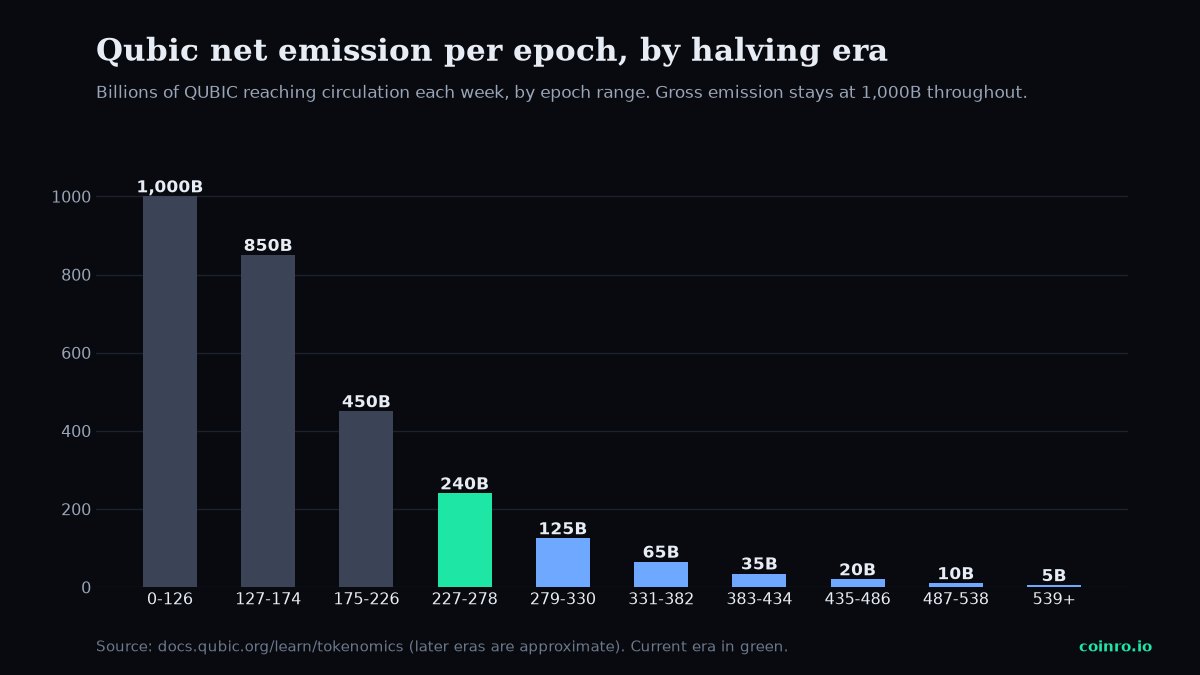
A Qubic halving leaves the 1 trillion gross emission alone and raises the share that is burned, so less reaches computors and miners.
Epoch 175 in August 2025 took net emission from 850B to 450B. Epoch 227, around 19 Aug 2026, took it to 225B in the project’s blog and about 240B in the docs table.
The next cut lands at epoch 279, projected for August 2027, at about 125B, then repeats every 52 epochs. The calculator applies that step to your payout from epoch 279.
Without the higher burn, Qubic’s halving post says the 200 trillion cap could be reached within 50 to 70 weeks of June 2026. Qubic’s post names this as the most concrete reason for the halving.
Worked example: one RTX 4090 at $0.10 per kWh
Take the 4090 preset: 360 it/s, 450 W, a 7% pool fee, the QLI payout of 141,705 and a QUBIC price of $0.000000533. It mines about 47.4 million QUBIC a week, worth $25.30.
Electricity is 75.6 kWh, or $7.56. That leaves $17.74 a week, about $77 a month.
The payout you need to break even is 42,346 QUBIC per it/s, which is 30% of the QLI estimate. If the real payout is a third of QLI’s figure, the margin is almost gone.
Halve the payout and the same card nets $5.09 a week. Now take a small rig at 48 it/s drawing 300 W, both figures assumed for illustration: it earns $3.37 and pays $5.04, a loss of $1.67 a week.
Compare the result with simply buying the token using the crypto ROI calculator, or with a staking return from the staking yield calculator.
Did Qubic really mine Monero, and what happened to Dogecoin?
For about a year Qubic aimed part of its CPU time at Monero’s RandomX algorithm, sold the XMR and used the money to buy and burn QUBIC or pay miner bonuses. Qubic’s epoch 178 recap counted about 723 XMR and 7 million Tari in one epoch, worth roughly $290,700.
| Date | What happened | Source |
|---|---|---|
| 11 Aug 2025 | Qubic says it completed a 51% takeover of Monero | Qubic blog, CoinDesk 12 Aug 2025 |
| 14 Sep 2025 | 18-block Monero reorganisation, 118 transactions invalidated | Qubic epoch 178 recap, its own account |
| 1 Dec 2025 | arXiv paper finds no sustained majority | arXiv 2512.01437, accepted at AFT 2026 |
| 1 Apr 2026 | Dogecoin mining starts, XMR phased out over three phases | Qubic blog, 27 Mar 2026 |
| Epoch 228, late Aug 2026 | Ant colony mining replaces the old scoring | Qubic blog, 4 Sep 2026 |
| 17 Sep 2026 | XMR and Dogecoin mining described as wound down | All-Hands Q&A, 22 Sep 2026 |
The paper measured Qubic’s Monero share at 23.38% on average. Hourly readings sometimes approached or passed 50%, but daily and weekly figures never reached 51%, and Qubic ended 4.0% behind the blocks honest mining would have earned. It still produced more orphaned blocks and deeper reorganisations.
Dogecoin was the ASIC route. Qubic’s own six-epoch data claimed $1.04 to $1.23 per GH/s per day against $0.58 on conventional pools, a project-authored comparison. On 30 Sep 2026 QLI’s Dogecoin pool API showed 0 H/s and 0 miners, so a Scrypt ASIC has no job on Qubic today.
Works for you
- CPUs and GPUs you already own can earn something
- Payout arrives weekly in one lump
- Live epoch and price data are publicly checkable
Works against you
- No trustworthy per-it/s payout figure exists right now
- The pool shrinks about 48% at epoch 279
- Rewards arrive as a thinly traded token
How to start mining Qubic
- Check your hardware. The Qubic Academy recommends AMD CPUs with AVX-512, and the QLI hashrates page lists what each card reports. Mine with a GPU only if its it/s per watt beats the break-even line in the chart.
- Create a wallet from official sources. Type qubic.org or github.com/qubic yourself. After the July 2026 GitHub compromise, download miner software only from the official organisation or your pool’s own docs.
- Pick a pool and split the risk. QLI (PPS+, 7%), Minerlab (7%, solo or PPS) and Jetski (7% PPLNS or solo) all take QUBIC. On 30 Sep 2026 miningpoolstats.stream showed Jetski with 85.5% of known pool hashrate, so spreading out helps the network.
- Run one full epoch before you judge. Minerlab pays on Wednesday at 4 PM UTC after the epoch and warns that leaving mid-epoch can forfeit rewards.
- Replace the estimate with your own number. Divide the QUBIC you received by your average it/s, type it into the payout field and choose “My own rate”.
Risks to price in
The payout model changed at epoch 224 and again at epoch 228, and QLI’s estimator has not caught up. Your dashboard after one epoch is the only number worth trusting.
QUBIC peaked at $0.00001256 on 2 Mar 2024 and trades near $0.00000053, about 96% lower, after gaining 32% in seven days. Bitbase measured about $6,253 of buy-side depth within 2% on LBank on 14 Aug 2026, so selling a week of mining rewards can move the price.
The pool of 181.64B QUBIC halves again around epoch 279. On 13 Jul 2026 an attacker took over a contributor account and pushed malicious code into the Core-Lite Docker image and the web wallet, and Bitbase found no public third-party audit of Qubic Core.
The Monero episode drew a backlash, and Kraken paused XMR deposits during it, per Bitbase. Most profitability claims above come from Qubic itself.
Qubic mining videos worth watching
Qubic mining FAQ
What is Qubic (QUBIC)?
Qubic is a layer-1 blockchain run by 676 computors that settle state by quorum vote. Miners train AI networks for the Aigarth project as useful proof of work. QUBIC is burned when used, and the supply is capped at 200 trillion tokens.
Is Qubic mining profitable in 2026?
It depends on your efficiency and power price. At QLI’s estimate, an RTX 4090 nets about $17.74 a week at $0.10 per kWh, while a hypothetical 48 it/s rig drawing 300 W loses $1.67. QLI says its estimates are currently not valid, so verify with one epoch of real payouts.
How much does 1 it/s earn on Qubic?
QLI’s pool API estimated 141,705 QUBIC per it/s per week on 30 Sep 2026, before its 7% fee. That is about $0.08 at current prices. QLI’s own page warns the figure may differ significantly from actual payouts under the new algorithm.
Does Qubic still mine Monero or Dogecoin?
Not at the moment. Qubic’s 17 Sep 2026 All-Hands said XMR and Dogecoin mining had wound down as the network moved to the ant colony miner. QLI’s Dogecoin pool API showed 0 H/s and 0 miners on 30 Sep 2026.
When is the next Qubic halving?
The next halving is projected for epoch 279, around August 2027. It raises the burn rate again and cuts net emission from about 240B to about 125B QUBIC per epoch, roughly 48% lower. Halvings then repeat every 52 epochs after that.
More mining and staking calculators
Estimates only, not financial advice. Mining revenue depends on the algorithm in force, network it/s, coin price, pool luck and uptime, and Qubic’s payout model changed twice in the two months before this page was written. Hardware figures come from the QLI hashrates page and manufacturer specifications. Profitability claims by Qubic are the project’s own.