Nockchain Mining Calculator: What Merge-Mining NOCK with Pearl Really Adds
Enter your GPU and your power price. The calculator reads the live NOCK network from LuckyPool, adds the Pearl side if you merge-mine, and applies the 25% miner reward cut due in late October.
Nockchain profit calculator
loading live dataAssumptions: NOCK per day equals your hashrate times the AI lane’s blocks per day times the miner reward, divided by the lane’s network hashrate. The reward follows the Aletheia table by block height, with the chain advancing at the live block time. Network growth keeps AI blocks per day constant, as the difficulty algorithm does. Merge mining counts your Pearl Th/s as the same number of NOCK TMAC/s unless you change the equivalence field. Prices stay flat, the miner switches off in any month it would lose money, and pool luck, payout thresholds, downtime and exchange fees are ignored.
How Nockchain mining pays you
Nockchain is a proof-of-work Layer 1 that launched on 21 May 2025 with a genesis block tied to Bitcoin block 897,767. The roadmap calls it a verifiably fair launch, and Zorp was the original developer.
Blocks come from two lanes. ZK-PoW proves a fixed Nock computation with a STARK, and AI-PoW runs the same noised INT8 matrix multiplication that Pearl uses. The AI lane went live in August 2026 under the Logos upgrade, at block 126,000.
Both lanes pay 2,048 NOCK per block today. The miner keeps 80%, which is the 1,638.4 NOCK LuckyPool reports, and a protocol fund takes 20%.
At 300 Th/s against an AI lane of 20.1 EH/s you hold about 0.0015% of it. That is 7.9 NOCK a day after a 1% pool fee and a 2% miner fee, or $0.18 at $0.0234.
Can you merge-mine NOCK with Pearl?
Yes, on LuckyPool and PearlHash. On LuckyPool you enter your Pearl address, a plus sign, your native NOCK address and the worker name. Your miner has to support merge mining, or it keeps mining Pearl only.
The protocol side is documented. The Logos specification says one Pearl proof can be accepted by both chains because the certificate binds the same parameters, and that one proof can produce only one Nockchain block.
What stays unproven is the exchange rate between your Pearl hashrate and NOCK hashrate. Consensus prices AI work in Pearl MAC equivalents, and the Anthropos specification uses 400 TMAC/s as the Pearl reference for an RTX 5090.
That sits inside the 300 to 418 Th/s Pearl sources quote for the card, so the calculator defaults to one Pearl Th/s equal to one NOCK TMAC/s. It is my reading, and the equivalence field lets you test it.
Two live numbers argue against assuming everything counts. LuckyPool’s Pearl pool runs 3.28 EH/s from 16,945 workers, while its NOCK side shows 1.66 EH/s from 6,742, which suggests only part of the pool has added a NOCK address. LuckyPool does not publish how it credits NOCK shares.
The lane mix is also moving. The AI lane produced 38 of the last 58 blocks on 30 Sep, at a 260.5 second interval against the 214 seconds the Anthropos draft targets. The repository still labels that specification a draft, so I cannot confirm it activated.
How fast is your GPU on NOCK?
Golden Miner publishes reference hashrates for its dual Nockchain and Pearl miner, version 0.1.3. The table applies them to the live network with a 1% pool fee and a 2% miner fee.
| GPU | Listed rate | Power | NOCK per day | NOCK $/day | Power $/day | Net, NOCK only |
|---|---|---|---|---|---|---|
| RTX 5090 | 333.5 | 575 W | 8.77 | $0.21 | $1.38 | -$1.17 |
| RTX 4090 | 290.9 | 450 W | 7.65 | $0.18 | $1.08 | -$0.90 |
| H100 | 255.3 | 350 W | 6.71 | $0.16 | $0.84 | -$0.68 |
| RTX 5070 Ti | 178 | 250 W | 4.68 | $0.11 | $0.60 | -$0.49 |
| RTX 4060 Ti | 78.6 | 125 W | 2.07 | $0.05 | $0.30 | -$0.25 |
| B200 | 598.5 | 1,000 W | 15.73 | $0.37 | $2.40 | -$2.03 |
The README prints no unit. I read the numbers as TMAC/s because a 5090 at 333.5 lands next to Pearl’s 300 to 418 Th/s, and the power column is the authors’ power limit. Electricity is $0.10/kWh and NOCK is $0.0234.
Every card loses money on NOCK alone. The same hashrate on Pearl is what pays the power bill.
The ZK lane is not in the calculator. It pays the same 1,638.4 NOCK per block but needs different software, and I could not verify its speed.
The Anthropos specification lists 28 MH/s as the ZK reference for a 5090, and the pool API shows the lane at 75.5 GH/s. On that basis a 5090 would earn roughly 106 NOCK a day before fees, about 13 times the 8.1 it earns in the AI lane at 300 Th/s.
I found no independent ZK miner benchmark at that speed, so treat it as arithmetic.
Worked examples: a merge-mined 5090 and a NOCK-only one
You run 300 Th/s at 420 W, pay $0.10/kWh, use LuckyPool’s 1% fee and a 2% miner. Pearl difficulty is 33.09M, PRL is $1.32, NOCK is $0.0234 and the AI lane is 20.06 EH/s at 260.5 seconds.
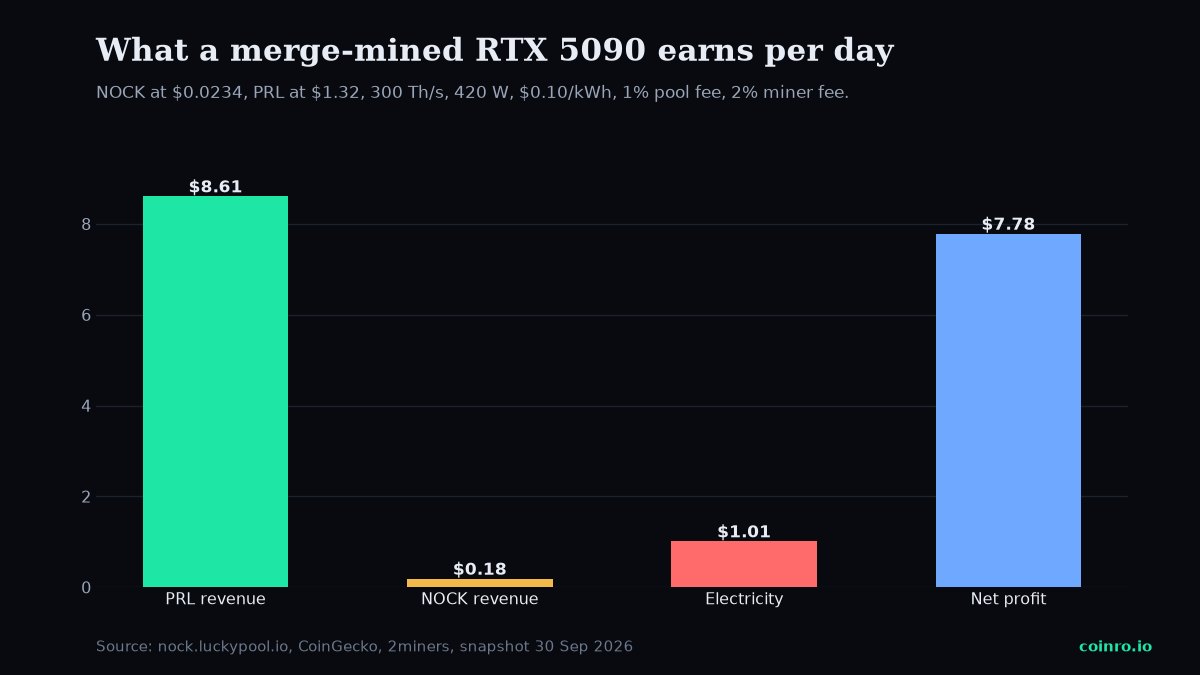
It mines 6.52 PRL and 7.89 NOCK a day. Revenue is $8.61 plus $0.18, and power costs $1.01, so you keep $7.78 a day, about $237 a month.
NOCK adds $5.62 a month. Over 12 months, with 10% monthly growth on both networks and the late-October reward cut, the combined result is $1,264 against $1,233 for PRL alone.
At 7.9 NOCK a day you reach the 50 NOCK minimum payout in 6.3 days. The 300 NOCK default takes 38. If only half your hashrate counted on NOCK, the daily add falls to $0.09.
Same inputs, no Pearl. NOCK revenue is $0.18 a day against $1.01 of electricity, a loss of $0.82 a day or about $25 a month.
You need NOCK at $0.128, 5.5 times today’s price, to break even. Or you need power at $0.018/kWh.
At $0.10/kWh the miner in the calculator switches off in month 1.
NOCK emission schedule and the next reward cut
Since the Aletheia upgrade on 6 May 2026, block time is 150 seconds and each block issues 2,048 NOCK. That change halved issuance per unit of time.
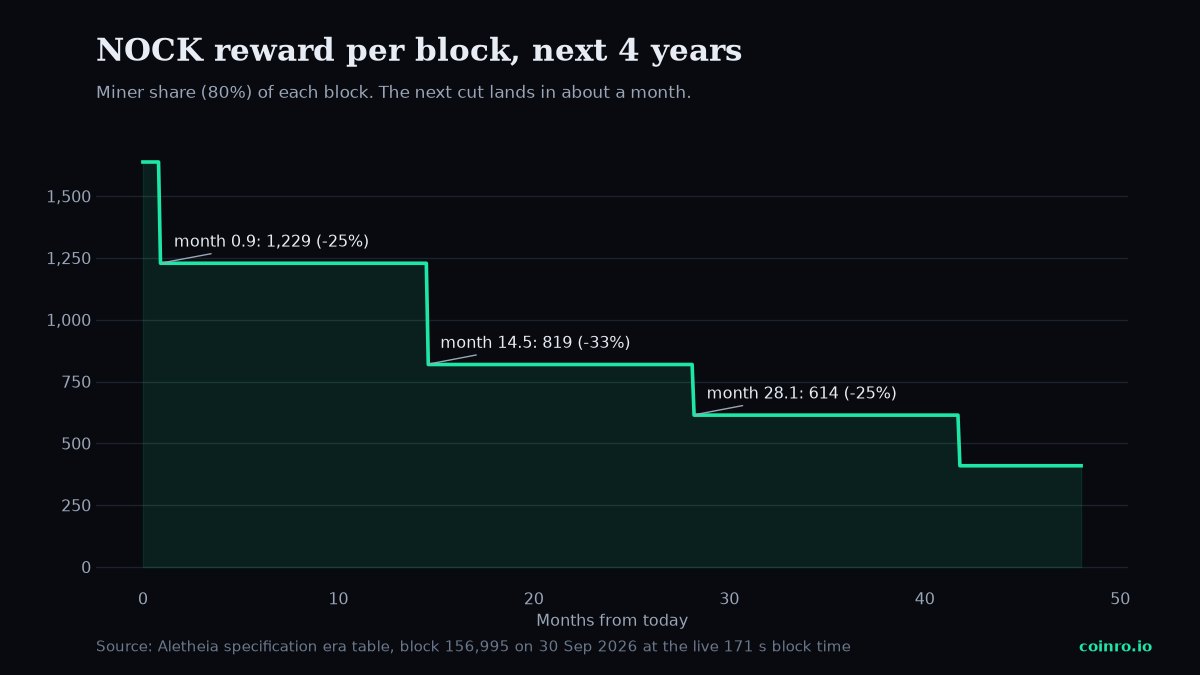
The next step is at block 170,501, 13,506 blocks from block 156,995. At the live 171 second block time that is about 27 days, or 23 days at the 150 second target. The miner reward falls 25%, from 1,638.4 to 1,228.8 NOCK.
| Era | Blocks | Issued per block | Miner gets (80%) | Step |
|---|---|---|---|---|
| 3, now | 65,501 to 170,500 | 2,048 | 1,638.4 | half per unit time |
| 4 | 170,501 to 380,500 | 1,536 | 1,228.8 | -25% |
| 5 | 380,501 to 590,500 | 1,024 | 819.2 | -33% |
| 6 | 590,501 to 800,500 | 768 | 614.4 | -25% |
| 7 | 800,501 to 1,010,500 | 512 | 409.6 | -33% |
| Tail | 2,060,501 to 16,144,876 | 64 | 51.2 | floor |
There are no halvings. Nine steps alternate between 25% and 33%, then a 64 NOCK floor runs to block 16,144,876, where issuance reaches exactly 2^32 coins.
The 20% fund share works out to about 207,000 NOCK a day at 506 blocks, roughly $4,850 at today’s price. That is my arithmetic, not a published figure.
What happened to Zorp, the 79% miner and the July exploit?
Zorp shut down in July 2026, and the chain kept producing blocks. The table lists who reported each step.
| Date | What happened | Source |
|---|---|---|
| 21 May 2025 | Mainnet launches | nockchain.org roadmap |
| 6 May 2026 | Aletheia: ASERT, 150 s blocks, new emission curve, 20% protocol fund | Roadmap, Aletheia spec |
| 26 Jun 2026 | Kraken opens NOCK trading | Kraken blog |
| 15 to 18 Jul 2026 | One mining operation rises from about half of blocks to 79%, then falls under 20% within nine days | Crypto Sleeping Giants, unverified |
| July 2026 | A proof-padding exploit is found and patched at block 112,500 in about a day | Same video, Zoe spec draft |
| 20 Jul 2026 | Zorp announces it has shut down | @ZorpZK, linked from the Nockchain docs |
| 17 Jul 2026 | Logos specification published; it adds the AI lane at block 126,000 | Logos spec, status now activated |
| Now | Nock Community Co. coordinates the 20% fund and the Base bridge with four independent parties | Nockchain docs |
Zorp built the original protocol and first mainnet, and raised a $5M seed round led by Delphi Ventures in January 2024, per the Nockchain docs.
The exploit, per the video, let a miner submit cheap hash attempts that inflated the proof rate. It says no invalid proof was accepted and no funds were at risk. The Zoe draft specification describes closing a “coefficient-permutation grinding channel” and cites the same block 112,500 anchor.
I could not verify the 79% figure against chain data. The docs name the four parties behind the fund and bridge signatories: Nock Community Co., NockBox, Southwest Pool Supply Co. and Lambda Collective. Four parties is still a small group to oversee 20% of every block.
Works for you
- Merge mining adds NOCK with no extra power
- The AI lane’s rules are public in the Logos specification
- The 20% fund pays for development
Works against you
- NOCK adds about 2% to a Pearl rig’s revenue
- A 25% reward cut lands in about 27 days
- One miner reportedly held 79% of blocks
How to start merge-mining NOCK with Pearl
- Check your card. Pearl needs an RTX 20 series or newer. The Pearl calculator covers the GPU list and the PRL side.
- Create a native NOCK wallet. Use Iris Wallet. Do not use a Base address that starts with 0x, and do not mine to an exchange address.
- Pick a miner that supports merge mining. Rabid Mining used WildRig on PearlHash with a 0% miner fee. Golden Miner ships a dual Nockchain and Pearl miner.
- Connect and check. On LuckyPool, use port 3360 under 500 Th/s, 3361 from 500 to 1,000 and 3362 above. Look up your NOCK stats at nock.luckypool.io.
NOCK also trades as a wrapped token on Base. LuckyPool pays on Nockchain itself, so a 0x address cannot receive it.
The roadmap lists bridge withdrawals as planned for Q1 2027, so Base NOCK cannot move back to the native chain yet.
Risks to price in
Standalone NOCK mining loses money at $0.10/kWh on every card above. The merge add-on is about 2% of a Pearl rig’s revenue, and it shrinks 25% when block 170,501 arrives.
Liquidity is thin. CoinGecko shows $0.81M of 24h volume against a $54.7M market cap, and the fully diluted value is $100.5M. Aerodrome on Base and LBank carry about 38% each, MEXC 14% and Kraken only $8,400.
Price fell 31.7% in 7 days and rose 48% in 30. It sits 89% under the $0.2102 high of 17 Oct 2025 and 5.3 times above the $0.0044 low of 15 Apr 2026.
A proof-padding exploit needed a hotfix in July, and I found no published third-party audit of AI-PoW. The hashrate equivalence with Pearl is an assumption, and the ZK lane’s economics are unverified.
Download miners only from the links above.
Nockchain mining videos worth watching
Nockchain mining FAQ
Is Nockchain mining profitable?
On its own, no. A 300 Th/s RTX 5090 earns about $0.18 a day in NOCK against $1.01 of power at $0.10/kWh, using 30 Sep 2026 figures. It pays only as an add-on to Pearl, where the same hashrate earns NOCK at no extra power cost.
Can you merge-mine NOCK and Pearl?
Yes, on LuckyPool and PearlHash. On LuckyPool you enter your Pearl address, a plus sign and your native NOCK address, with a miner that supports merge mining. One Pearl proof can count on both chains, but the pool does not publish how it credits NOCK shares.
How much NOCK does a GPU mine per day?
An RTX 5090 at 300 Th/s mines about 7.9 NOCK a day after a 1% pool fee and a 2% miner fee, or $0.18. It scales with your hashrate and the AI lane’s 20.1 EH/s, and the miner reward drops 25% at block 170,501.
What is Nockchain’s max supply and emission?
Supply is capped at 4,294,967,296 NOCK and about 2.34 billion exist. Each block issues 2,048 NOCK, 80% to the miner and 20% to a protocol fund, falling in nine 25% or 33% steps to a 64 NOCK floor, with no halvings.
What happened to Zorp, the company behind Nockchain?
Zorp announced on 20 July 2026 that it had shut down. The chain kept producing blocks, and Nockchain’s docs say Nock Community Co. now coordinates the 20% protocol fund and the Base bridge with three other parties.
More mining and staking calculators
Weighing a rig against simply buying the coin? Run the cost through the crypto ROI calculator, or compare with the staking yield calculator.
Estimates only, not financial advice. Mining revenue depends on network hashrate, coin price, pool luck and uptime, all of which change daily. GPU hashrates are the miner authors’ own figures. The equivalence between Pearl and NOCK hashrate is an assumption, the July 2026 miner share and exploit details come from a single YouTube source, and NOCK is a thinly traded asset.