Crypto Mining Calculators for 2026: What Still Pays at Your Power Price
Ten coins crypto Twitter is actually mining and staking right now, each with its own live calculator. Start with the power price check below. It tells you in ten seconds which rig makes money where you live.
Power price check
loading live data| Coin | Rig | Mined / day | Revenue / day | Power / day | Profit / day |
|---|
One rig per coin at manufacturer specs, 1% pool fee, today’s price and network size. Pearl uses WhatToMine’s conservative 300 Th/s for an RTX 5090. Open each coin’s page for hardware cost, payback and difficulty growth.
Pick your calculator
Stake
Mine
Mining vs staking: two different bets
Mining turns electricity into coins. Your margin is the coin price minus your power bill, and a new ASIC generation can wipe it out overnight.
Staking turns coins into more coins. No power bill, but your whole principal rides on the token price, and the yield is often paid in something more volatile than what you put in.
| Coin | How you earn | Entry cost | What breaks the math |
|---|---|---|---|
| Bittensor | Stake TAO to a validator, or run a subnet miner | Any TAO amount; miners need hardware or API spend plus a registration burn | Alpha price drops, validator take, deregistration |
| Pearl | GPU mining with useful-work proofs | A modern NVIDIA GPU | Difficulty growth, thin PRL liquidity |
| NetNet | Stake NET, rebases every 8 hours | NET bought with a 5% levy, or a bond | Premium over backing collapsing |
| Kaspa | kHeavyHash ASIC mining | $1,700 and up per ASIC | Monthly emission cut plus new Bitmain models |
| Zcash | Equihash ASIC mining | $5,500 to $13,400 per ASIC | ZEC giving back its 2026 rally |
| Monero | CPU or RandomX ASIC mining | A CPU you already own | An algorithm change that bricks the X9 |
| Hyperliquid | Delegate HYPE to a validator | Any HYPE amount | Low base APR, 7-day unstaking queue, validator jailing |
| Nockchain | GPU mining, alone or merged with Pearl | A modern NVIDIA GPU | 25% reward cuts, thin NOCK liquidity |
| Qubic | CPU or GPU mining for AI training work | A CPU or GPU you already own | Payout per it/s that pools cannot currently estimate |
| Aleo | Prover ASIC mining | An IceRiver AE3 plus staked ALEO | The stake requirement and exchange depth |
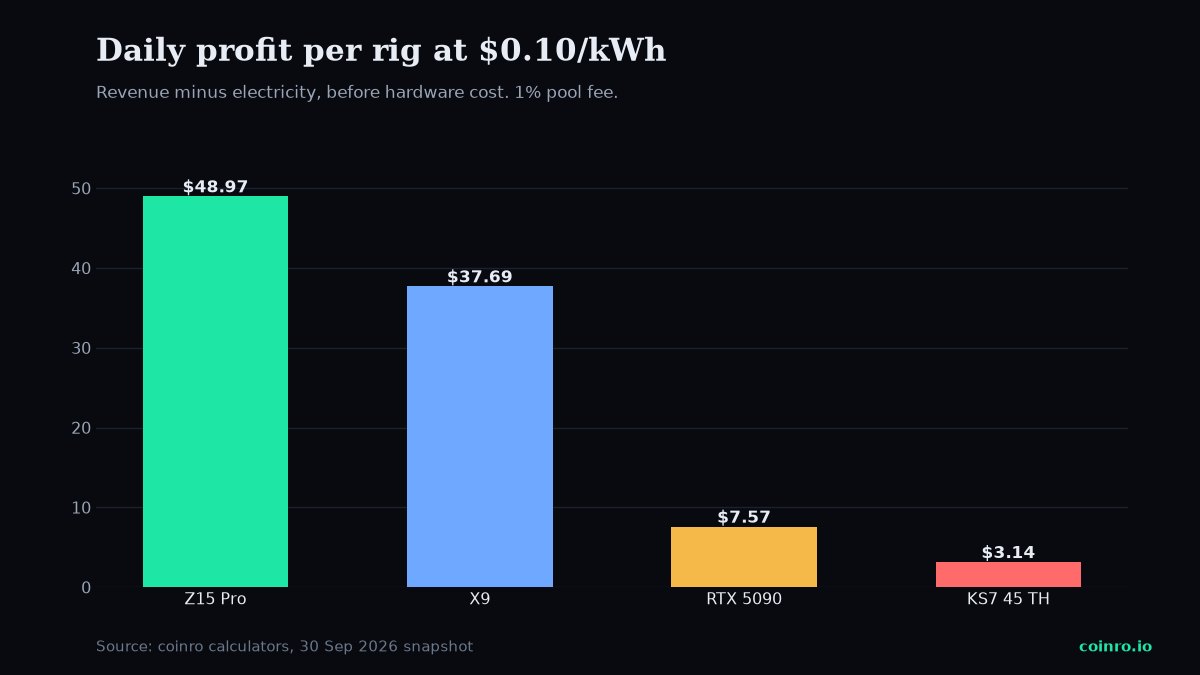
At $0.10/kWh a Z15 Pro burns $6.67 of power a day. At the ZEC price loaded above it mines several times that, which is why Zcash tops the check today.
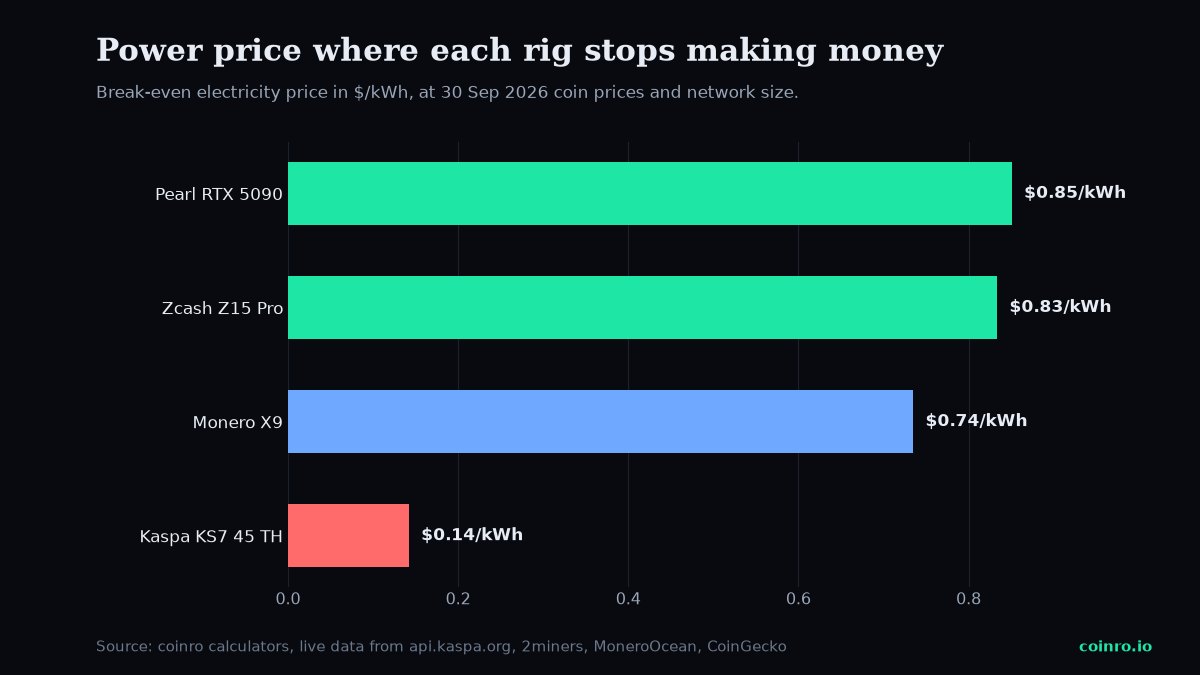
Slide the price to $0.25/kWh and watch the gap close. The X9 and Z15 Pro stay positive for a long way, while the KS7 turns negative around $0.14.
How to use these calculators without fooling yourself
- Use your real power price. Include delivery charges and taxes. A $0.05 error turns a KS7’s $3 daily profit into a loss.
- Add difficulty growth. Every coin page has a monthly difficulty slider. Zero is never the right answer after a price rally.
- Stress-test the price. Type a price 40% lower than today. If the rig only works at today’s price, you are betting on price, not mining.
- Count the exit. Pool payout thresholds, exchange fees, the 5% NetNet levy and alpha slippage all come out of your profit.
- Compare with buying. Put the hardware budget into the crypto ROI calculator as a plain buy. Mining has to beat that to be worth the noise.
A positive day is not a payback. A $13,400 Z15 Pro netting about $47 a day needs over nine months to earn back its price, and that assumes ZEC and difficulty hold still.
The Kaspa KS7 already loses money above $0.14/kWh. Every rig here is one price drop or one ASIC generation away from the same place.
Staking yields in the double digits almost always come with a token that can fall faster than it pays.
Two videos to watch before you buy hardware
Mining calculator FAQ
What is the most profitable coin to mine in 2026?
At $0.10/kWh the Zcash Z15 Pro and the Monero X9 lead the power price check, netting about $47 and $38 a day on 30 Sep 2026 figures. The ranking moves with every price swing and difficulty change, so reload the table above and test a lower coin price before you decide.
Is crypto mining still profitable at home?
It depends on the coin. At the US average of about $0.17/kWh a Kaspa KS7 loses money, while the Zcash and Monero ASICs stay positive at today’s prices. A GPU mining Pearl costs under $2 a day to run, but difficulty growth and a thin PRL market can erase that margin.
Is staking better than mining?
Staking has no power bill or hardware, but your full balance rides on the token price, and double-digit yields usually arrive in a volatile token. Mining risk sits in hardware and electricity. Pick the risk you can check and price before you commit.
How accurate are mining calculators?
They are exact for today and wrong for next month. Network difficulty and coin price change daily, so treat any payback period longer than 12 months as a guess. Add monthly difficulty growth and test a price 40% lower before you buy hardware.
Which mining calculator should I start with?
Start with the coin your hardware already fits. A gaming GPU points to Pearl, a spare CPU to Monero, and a budget over $2,000 to the Kaspa or Zcash ASIC pages. Hardware-free staking fits Bittensor or NetNet, and both carry token price risk.
Looking for yield without hardware? The staking yield calculator covers ETH, SOL, ADA and other proof-of-stake coins.
Estimates only, not financial advice. Figures use manufacturer specs and live network data that change every block. Mining and staking can lose money.