Monero Mining Calculator: Can a CPU Still Beat Bitmain’s X9?
Enter your CPU or ASIC, your power price and your pool fee. The calculator pulls live Monero difficulty and price, then projects profit month by month, including a stress test for a RandomX change that cuts your hashrate.
Monero profit calculator
loading live dataAssumptions: 720 blocks a day at the live block reward (0.6 XMR tail emission plus fees), so there is no emission cut to model. Price stays flat at the value you enter. Difficulty growth compounds monthly, and the RandomX change multiplies your hashrate from the month you pick. The miner switches off in any month it would lose money. Pool luck, downtime and resale value are ignored.
How much Monero can you mine per day?
Monero targets one block every 120 seconds, so 720 blocks a day. Each block pays 0.6 XMR of tail emission plus fees, which is about 436 XMR a day in total.
Your share equals your hashrate divided by the network hashrate. A 28.4 kH/s Ryzen 9 9950X holds about 0.0005% of a 5.79 GH/s network, which works out to 0.0021 XMR a day.
Because the reward never halves, the only moving parts are difficulty and price. That makes Monero the simplest coin on this site to model.
Monero mining hardware: Antminer X9 vs CPUs
A CPU hits a wall set by memory latency. The RandomX v2 design document notes that a 2026 Ryzen 9 9950X is only 20 to 25% faster at RandomX than the 2019 Ryzen 9 3950X, even though it wins most other benchmarks by 1.5 times.
The X9 skips that wall. Bitmain lists 1,000 kH/s at 2,472 W and $5,600, with 220 to 277 V input.
| Device | Type | RandomX hashrate | Power | Efficiency | Price |
|---|---|---|---|---|---|
| Bitmain Antminer X9 | RandomX ASIC | 1,000 kH/s | 2,472 W | 2.47 J/kH | $5,600 |
| Ryzen 9 9950X | 16-core CPU | 28.42 kH/s | 170 W TDP | 5.98 J/kH | not checked |
| Ryzen 9 7950X | 16-core CPU | 26.96 kH/s | 170 W TDP | 6.31 J/kH | not checked |
| Ryzen 9 5950X | 16-core CPU | 23.37 kH/s | 105 W TDP | 4.49 J/kH | not checked |
| Ryzen 7 7840HS | Laptop CPU | 5.57 kH/s | 54 W TDP | 9.70 J/kH | not checked |
Sources: Bitmain’s product announcement, xmrig.com/benchmark multi-thread RandomX results read on 30 Sep 2026 (1,079 samples for the 9950X, 1,720 for the 7950X, 7,032 for the 5950X, 43 for the 7840HS), and AMD product pages for TDP.
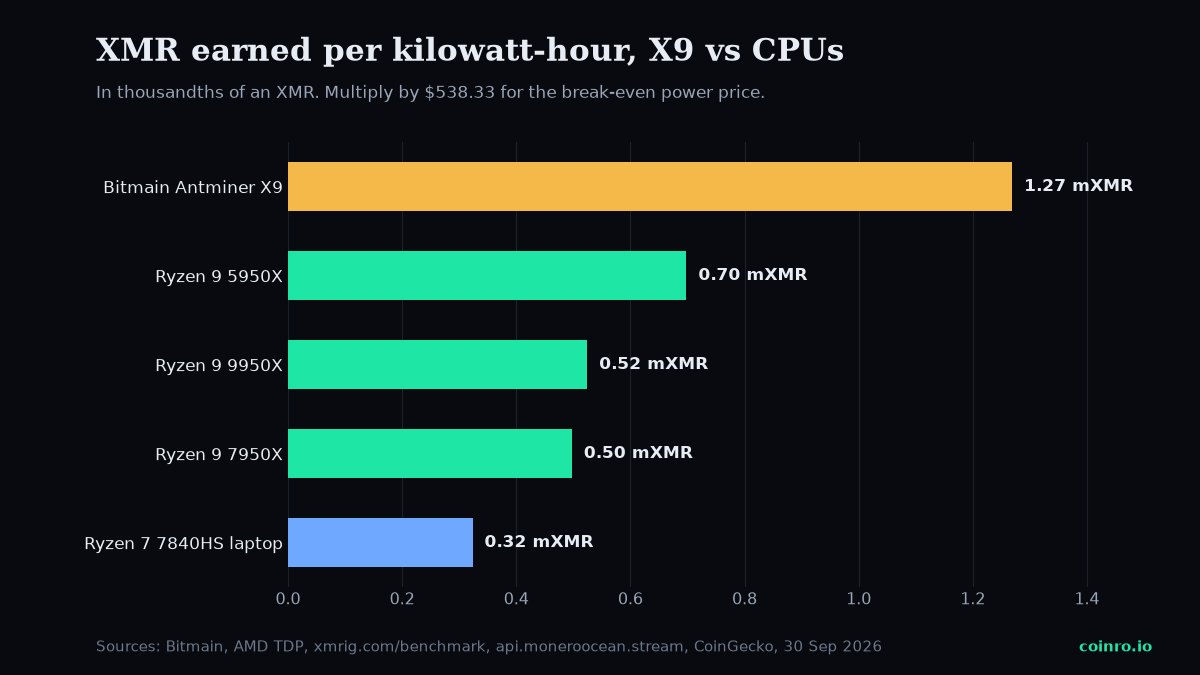
TDP is a CPU-only figure, so the CPU efficiency numbers flatter the CPUs. Even so, the X9 beats the best one by only 1.8 times on electricity. Its real edge is raw hashrate: one unit equals 35 Ryzen 9 9950X machines.
Will RandomX v2 or the FCMP++ fork break the X9?
Not yet, and no mainnet date exists. On 30 Sep 2026 a public Monero node answered the hard_fork_info call with version 16, the same fork the network has run since 2022.
The change aimed at ASICs is RandomX v2. Its design document cuts how often the rounding mode flips, mixes AES into the main loop and grows the program from 256 to 384 instructions.
The unofficial Monero Research Lab account said in January 2026 that it was nearly complete and could reduce ASIC efficiency significantly.
The vehicle is the v17 hard fork, the one built around FCMP++ privacy. The monero-project milestone for that fork lists “support RandomX V2 and commitments in v17” as pull request 10038.
That pull request had not been approved at the 16 Sep 2026 Research Lab meeting. XMRig’s maintainer said it still carried controversial changes on top of RandomX v2.
Developers discussed a 6-month wait between the first fork-ready binary and activation, mainly so miners can update XMRig (Tech Meeting 27 Jul 2026). The beta stressnet v3 released 25 Sep 2026 already includes RandomX v2, but it is a test network.
RandomX v2 has not activated on Monero mainnet and I found no announced activation date. Some 2026 blog posts say FCMP++ shipped in August. The live node still reports fork version 16, so those posts look wrong as of this date.
asicminervalue lists the X9 as released in August 2026, but I could not confirm that units have reached customers. Use the stress-test preset to see what a fork does to your payback.
A fork would not hit every machine equally. Early xmrig.com results for RandomX v2 show the 9950X flat at 28.44 kH/s, but the 7950X at 19.59 kH/s (down 27%) and the 5950X at 14.92 kH/s (down 36%).
Those v2 samples are tiny, at 12, 3 and 6 submissions. Your older CPU could lose more than the X9 does.
Worked examples: an X9 and a Ryzen 9 9950X
You buy an Antminer X9 for $5,600 and pay $0.10/kWh. At today’s difficulty it mines about 0.0753 XMR a day, worth $40.52, and burns 59.3 kWh costing $5.93.
That leaves $34.59 a day, or $1,053 a month. With 2% monthly difficulty growth, payback lands in month 6 and the cumulative result after 24 months is $13,629.
Now halve its hashrate in month 12 with the stress-test preset. The same 24 months end at $7,944, and payback still lands in month 6 because the damage comes after.
You already own a Ryzen 9 9950X and pay $0.15/kWh. It mines 0.00214 XMR a day, worth $1.15, and its 170 W TDP costs $0.61 a day.
That leaves $0.54 a day, about $16 a month. Break-even sits at $0.28/kWh, and a whole PC draws more than the CPU’s TDP, so your real margin is thinner.
On P2Pool you will see the payout land in small pieces. Solo, the 9950X expects one 0.6 XMR block, about $326, every 283 days.
Compare either result with simply buying XMR in the crypto ROI calculator. Monero has no staking, but the staking yield calculator shows what the same capital earns on proof-of-stake coins.
Works for you
- Tail emission means the reward never halves
- You can mine with a PC you already own
- P2Pool pays with 0% fee and no custodian
Works against you
- A CPU nets under a dollar a day at $0.10/kWh
- Difficulty climbs when ASICs arrive
- Early RandomX v2 samples show older CPUs losing up to a third
P2Pool vs a normal Monero pool
P2Pool is a decentralised pool that runs on your own Monero node. It pays from the coinbase transaction itself, so nobody holds your balance.
A normal pool is easier, but the top two pools hold a large slice of the network. SupportXMR and Nanopool together carry 51.9% of the hashrate the tracker knows about.
| Pool | Fee | Min payout | Hashrate | Miners | Custody |
|---|---|---|---|---|---|
| P2Pool mini | 0% | about 0.00027 XMR | 27.35 MH/s | 2,065 | Self, via your node |
| P2Pool main | 0% | about 0.00027 XMR | 480 MH/s | 589 | Self, via your node |
| MoneroOcean | 0% | 0.003 XMR | 209 MH/s | 4,472 | Pool |
| C3Pool | 0% | 0.001 XMR | 295 MH/s | 2,106 | Pool |
| SupportXMR | 0.6% | 0.1 XMR | 1.89 GH/s | 5,087 | Pool |
| HashVault | 0.9% | 0.001 XMR | 831 MH/s | 3,977 | Pool |
| Nanopool | 1% | 0.11 XMR | 1.31 GH/s | 1,929 | Pool |
Sources: miningpoolstats.stream/monero on 30 Sep 2026, the P2Pool README for the P2Pool minimum payout, and the MoneroOcean config API for its 0% fee.
On current numbers P2Pool mini finds a Monero block about every 7 hours (5.79 GH/s divided by 27.35 MH/s, times 120 seconds). Its payout window is 6 hours, so some of your shares expire unpaid. The README says this averages out over time.
Pick P2Pool mini if you run a small CPU and care about decentralisation. Pick MoneroOcean or C3Pool if you want a dashboard and no node to maintain.
How to start mining Monero on a CPU
- Price your power first. Read your rate per kWh on the bill, then compare it with your chip’s break-even price in the chart above.
- Create a wallet. Use the official Monero GUI or a wallet you trust, and write the seed phrase down offline.
- Benchmark your chip. Download XMRig only from xmrig.com and run its built-in benchmark. Compare the result with the xmrig.com/benchmark table for your CPU.
- Measure the wall draw. A plug-in power meter takes a minute. Enter the real watts in the calculator instead of the TDP.
- Choose a pool. Start on P2Pool mini if you can run a node, otherwise MoneroOcean. Check the dashboard after an hour.
RandomX needs 2,080 MB of RAM per NUMA node for its dataset plus 256 MB of cache, according to the XMRig optimization guide. Enable huge pages and leave the memory alone while it runs.
A 16-core CPU at full load pulls 170 W for weeks, and an X9 draws 2,472 W and needs a 220 to 277 V outlet. Plan the circuit and the room before you order.
Risks to price in
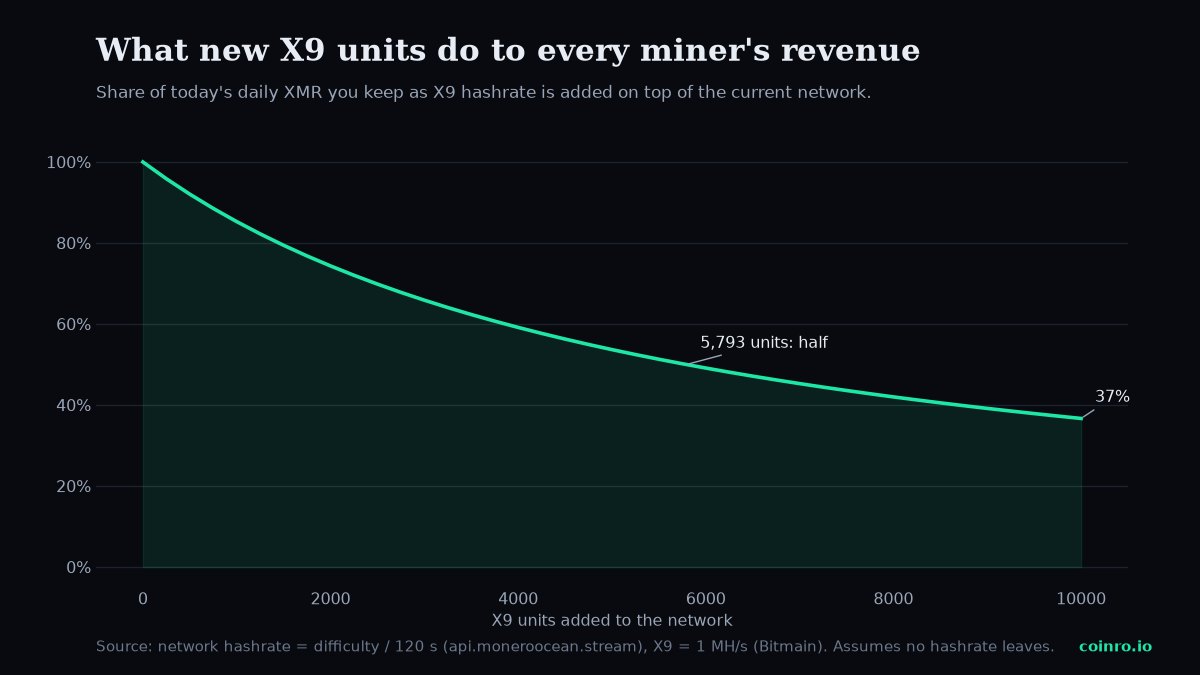
The X9 payback above assumes the network stays near today’s size. Pool trackers already estimate 6.44 GH/s from the last 100 blocks against 5.79 GH/s implied by difficulty, so difficulty is still catching up.
A RandomX v2 fork could strand a $5,600 machine. Older CPUs also lose hashrate under v2, so their payback changes too.
XMR can fall faster than difficulty. Type a lower price into the calculator to see where you break even.
Monero mining videos worth watching
Monero mining FAQ
Is Monero mining profitable in 2026?
It depends on your hardware and power price. A Ryzen 9 9950X makes about $0.74 a day after electricity at $0.10/kWh, using its 170 W TDP. It stops paying at about $0.28/kWh, and a whole PC draws more than the CPU alone.
Can you still mine Monero with a CPU?
Yes. RandomX still runs best on CPUs, and XMRig is the standard miner. Expect under a dollar a day after power from one CPU at $0.10/kWh. Use P2Pool or a pool, because a solo block can take most of a year.
How much does the Bitmain Antminer X9 earn per day?
At today’s difficulty and $538 XMR, one X9 mines about 0.0753 XMR, or $40.52 a day. At $0.10/kWh electricity costs $5.93, leaving $34.59 a day before difficulty growth. More ASICs on the network or a RandomX change would reduce that.
Will RandomX v2 make the X9 useless?
Nobody knows yet. RandomX v2 has not activated and no mainnet date exists as of 30 Sep 2026. It is planned for the v17 fork, and its authors say it could cut ASIC efficiency a lot, but no one has measured a shipped X9 against it.
Is P2Pool better than a normal Monero pool?
P2Pool charges 0% and never holds your funds, but you run a Monero node and your payouts are lumpy. A normal pool needs no node and pays on a steady schedule, at a fee of 0% to 1% on the pools listed above.
More mining and staking calculators
Estimates only, not financial advice. Mining revenue depends on network difficulty, coin price, pool luck and uptime, all of which change daily. Hardware specs are manufacturer figures. CPU hashrates are community submissions to xmrig.com/benchmark.