What Is a Seed Phrase Example? How the 12 or 24 Words Actually Work
A seed phrase example looks like this: “abandon abandon abandon abandon abandon abandon abandon abandon abandon abandon abandon about”. Twelve lowercase English words in a fixed order, and that exact phrase is the published test case from the BIP-39 standard every major wallet follows.
Every seed phrase has that shape. Either 12 or 24 common words, all drawn from one public list, all in a sequence that matters.
The example above is real, and it holds nothing
That phrase sits in the official BIP-39 test vectors, so it has been public for over a decade. Bots watch the wallet it restores around the clock, and anything sent there disappears in seconds.
It makes a safe teaching example for that reason. Your phrase has no password behind it, no username and no second factor, so publishing the words publishes the wallet.
That gets clearer once you see how a seed phrase differs from a private key. The two are linked, but they are not the same object.
The words come from a list of exactly 2048
Your wallet does not invent vocabulary. It draws from the BIP-39 English wordlist, which holds 2,048 entries sorted alphabetically.
The list was built so the first four letters identify any word without ambiguity. Type “aban” on a hardware wallet keypad and only “abandon” fits.
Confusable pairs were stripped out on purpose. You will not find both “build” and “built” in it, or both “woman” and “women”.
Why 12 or 24 words, and never 13
With 2,048 options, each word encodes 11 bits. The standard requires the underlying random number to be a multiple of 32 bits, between 128 and 256.
Take 128 bits of randomness, add a 4-bit checksum, and you get 132 bits. Divide by 11 and you land on exactly 12 words. Do it with 256 bits and an 8-bit checksum and 264 bits becomes 24 words.
Phrases of 15, 18 and 21 words are valid too. Almost no consumer wallet offers them, so in practice you get 12 or 24.
The final word is doing arithmetic, not vocabulary
Those checksum bits are folded into the last word. That is why the same all-zero input produces a 12-word phrase ending in “about” but a 24-word phrase ending in “art”.
Swap one word in your own phrase and most wallets reject it before showing a balance. The net is thin, though: the BIP-39 authors state that roughly 1 in 256 random errors slips through undetected.
A phrase your wallet accepts is not proof you transcribed it correctly. Write it on paper or steel and keep it off any connected device, the way a cold wallet setup assumes.
What a written example cannot teach you
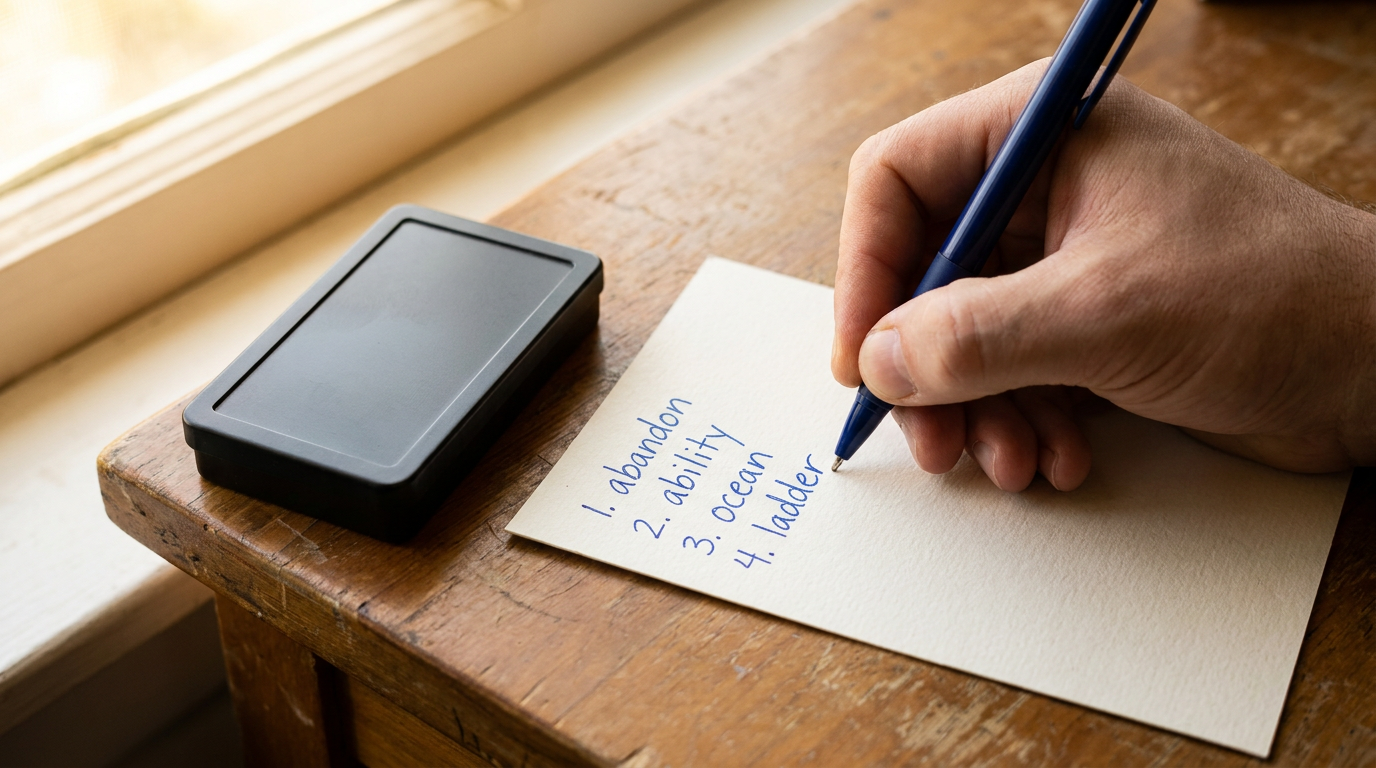
Order. Examples on a screen read like flat lists, so people copy the words and lose the sequence.
Number the slots 1 through 12 when you write yours down. Position is part of the data, and “about abandon abandon” opens a different wallet.
Repeated words are legal too, which trips people up. Another official test vector reads “legal winner thank year wave sausage worth useful legal winner thank yellow”, with three words showing up twice.
Still unsure what the words control? The short version is that a seed phrase is the wallet, not a login to it.
Can I use a seed phrase example from the internet to test a wallet?
You can restore one and look around an empty wallet, nothing more. Every published phrase, the ones on this page included, gets swept automatically.
Is a 24 word seed phrase safer than a 12 word one?
On paper yes, since it encodes 256 bits of randomness against 128. Both sit far outside brute-force range in practice. Real losses come from phrases that were photographed, lost, or typed into a fake support form.
Can I pick my own 12 words instead?
Rarely, and it is a bad trade. Your words would still need to come from the 2,048-word list with a matching checksum, and human-chosen sequences are much easier to guess than generated ones.